
Regulatory compliance laws affect how healthcare organizations operate. These regulations cover patient safety, data privacy, billing, staffing, and daily operations.
Noncompliance can lead to hefty fines, revoked licenses, payment delays, or loss of trust with patients and healthcare providers.
This guide discusses the definition and importance of healthcare compliance. You’ll also learn the key regulations to follow and how to ensure regulatory compliance.
Understanding Regulatory Compliance in Healthcare
Healthcare regulatory compliance means following the laws, rules, and standards that apply to healthcare organizations. Covered entities include hospitals, clinics, group practices, and direct patient care providers (e.g., doctors, nurses, and allied health professionals).
These rules guide how healthcare professionals provide care, safeguard patient data, bill payers, and run daily business practices.
Regulations also tell them what they can and cannot do when treating patients, storing records, or submitting claims. These legal obligations come from federal, state, and local authorities.
The Importance of Regulatory Compliance
Compliance in the healthcare industry is tied to patient safety, data privacy, and proper conduct. Here’s why compliance matters:
Ensure Patient Safety and Quality of Care
Laws and rules set strict standards for how healthcare organizations deliver care, train staff, and use equipment.
When your organization follows these regulations, patients receive care that meets accepted medical and safety expectations. In other words, you protect patients from harm.
Compliance also supports high-quality patient care by reducing errors, improving clinical processes, and setting clear limits on unsafe practices.
Prevent Legal and Financial Penalties
Failing to follow regulatory compliance in healthcare can lead to serious consequences. These include costly fines, civil penalties, payment takebacks, or loss of billing privileges.
In severe cases, violations tied to fraud or false claims can trigger criminal charges against the organization or its leaders.
Staying compliant lowers the risk of enforcement actions. This helps your healthcare facility avoid legal repercussions that can damage finances and long-term stability.
Safeguard Patient Privacy
Healthcare organizations manage large amounts of sensitive patient data. A single data breach can expose medical records and personal details.
It’s important to follow general data protection regulations to minimize the risk of data leaks and protect patient privacy. These laws limit who can view patient information and under what conditions.
Patients will feel safer sharing sensitive data, knowing that your organization is handling it securely.
Maintain Operational Continuity
Regulatory compliance supports smooth and predictable operations.
Clear rules set expectations for staff and reduce confusion about tasks, approvals, and responsibilities. When workflows follow compliance rules, internal teams spend less time fixing errors or redoing work. They can focus on care delivery and revenue generation.
Compliance also helps organizations avoid legal issues that can interrupt healthcare services, such as failed inspections, license problems, or enforcement actions.
Protect Your Organization’s Reputation
Regulatory compliance in healthcare plays a direct role in how your organization is viewed by the public and regulators.
When violations occur, news can spread quickly through audits, public reports, or lawsuits. This can damage patient trust and make it harder to hire healthcare professionals or attract investors.
Following compliance requirements shows that your organization respects the law and operates responsibly. A clean compliance record helps avoid public scrutiny and supports a positive image with patients, employees, insurers, and oversight agencies.
Which Regulatory Bodies Enforce Healthcare Compliance?
Several government agencies oversee regulatory compliance in healthcare. The following regulatory bodies establish rules, conduct audits, and take action when violations occur.
- U.S. Department of Health and Human Services (HHS): This federal department oversees major healthcare laws and programs.
- Office of Inspector General (OIG): They investigate fraud, waste, and abuse.
- Centers for Medicare and Medicaid Services (CMS): They impose billing and participation rules.
- Office for Civil Rights: This division within the U.S. HHS investigates discrimination complaints and oversees the data security of sensitive health information.
- State health departments: They enforce licensing and local healthcare laws.
Key Compliance Regulations in Healthcare
Healthcare organizations should follow several major laws that govern care delivery, data handling, safety, and ethical conduct. Here are the most popular regulations to comply with:
Health Insurance Portability and Accountability Act (HIPAA)
HIPAA sets national standards for how healthcare organizations handle sensitive health data. This law applies to doctors’ notes, insurance information, consent forms, electronic health records (EHRs), and verbal conversations with patients.
Under HIPAA, healthcare organizations should follow strict guidelines when collecting, storing, and sharing protected health information (PHI). Doing so guarantees patient data protection and confidentiality.
Healthcare entities must also comply with HIPAA’s privacy, security, and breach notification rules. These require the timely reporting of data breaches to the U.S. HHS and affected individuals.
Failure to follow HIPAA regulations can lead to audits and fines amounting to $1.5 million per year, depending on the exact violation.
Health Information Technology for Economic and Clinical Health (HITECH) Act
The HITECH Act expands on HIPAA by focusing on EHRs and digital healthcare systems. It increases liability for breaches and gives patients more rights over their health data.
HITECH encourages the secure use of digital technology while holding healthcare organizations accountable for weak safeguards.
It also places additional responsibility on healthcare leaders to monitor systems, manage vendors, and track how electronic data flows across digital platforms.
HITECH offers financial incentives to eligible providers for meeting “meaningful use” of EHRs. Those who fail to adopt EHRs responsibly or violate privacy rules receive costly penalties.
Occupational Safety and Health Act (OSHA)
The Occupational Safety and Health Act is a U.S. federal law that mandates employers in various industries (including healthcare) to provide a hazard-free environment. This ensures workplace safety and prevents both employee and patient harm.
It involves identifying and mitigating hazards through feasible changes, such as better ventilation or safer chemicals, rather than relying solely on personal protective equipment (PPE).
OSHA regulations also demand written plans for the following areas to address risks:
- Hazard communication
- Bloodborne pathogens
- Emergency action plans (EAP)
- Fire prevention plans (FPP)
- Respiratory protection
Noncompliance with the Act triggers enforcement actions by OSHA. These include citations, fines, and potential criminal penalties for willful violations.
Clinical Laboratory Improvement Amendments (CLIA)
The CLIA sets federal regulatory standards for clinical laboratory testing on humans in the United States. It makes sure test results used for diagnosis, treatment, or health assessments are accurate and reliable.
Diagnostic and pathology labs must remain compliant with CLIA to legally operate, as certification is mandatory before accepting human specimens for testing.
Staying compliant also allows your facility to receive reimbursement from the Centers for Medicare and Medicaid Services.
State Licensing Laws
State laws control who may operate a healthcare facility and provide medical services. These laws cover healthcare provider licenses, facility permits, and scope of practice rules.
Each state sets its own regulatory requirements. That’s why organizations operating in different states should comply with different rules.
For example, hospitals should keep licenses active, renew them on time, and report changes like ownership or location updates. Operating without proper licensing can lead to establishment closures, fines, or denied payments.
Licensing rules also affect staffing decisions and service offerings. Staying current with state laws helps healthcare organizations avoid interruptions tied to expired or invalid licenses.
Anti-Fraud Regulations
Anti-fraud laws control billing practices and financial conduct in healthcare. Two relevant regulations are the False Claims Act and the Stark Law.
The False Claims Act prohibits submitting false or inaccurate claims to government programs such as Medicare and Medicaid. This includes billing for services not provided, upcoding, or misrepresenting patient information. Violations can lead to large fines and repayment demands.
The Stark Law focuses on physician referrals. It restricts doctors from referring patients to entities with which they have certain financial relationships.
The goal is to prevent conflicts of interest and excessive billing for medical services. Claims linked to improper patient referrals may be denied, even if care was provided.
Anti-fraud regulations encourage healthcare organizations to maintain honest billing, clear documentation, and proper oversight of financial arrangements.
Emergency Medical Treatment and Labor Act (EMTALA)
EMTALA requires Medicare-affiliated hospitals to provide emergency medical treatment to anyone seeking immediate care, regardless of ability to pay.
Patient status, insurance, or background cannot affect access to emergency services.
Hospitals should conduct a medical screening to determine if the patient has an emergency medical condition (EMC). If an EMC is found, hospitals must treat patients until they are stabilized.
In cases in which the hospital can’t stabilize the patient, it should transfer the patient to another healthcare facility.
Violating EMTALA can lead to civil fines, exclusion from Medicare/Medicaid, and litigation.
How to Ensure Healthcare Regulatory Compliance
Follow the tips below to ensure compliance with healthcare regulations.
1. Identify Applicable Healthcare Regulations
Determine all laws and rules that apply to your healthcare organization. These include federal, state, and local requirements tied to care delivery, billing, data handling, and staffing.
Different services and locations may fall under varying rules. What’s legal in one state may be illegal in another.
You should also review contracts, licenses, and payer agreements to confirm obligations.
Early identification supports focused compliance efforts and lowers the risk of missing requirements that could trigger audits or penalties.
2. Develop a Compliance Program
Establish a compliance program to set clear expectations within your organization. Assign oversight to a qualified compliance officer who can manage policies, training, and reporting.
Document compliance processes, assign roles, and share response steps in writing.
Leadership involvement is also important so staff understand that compliance is a shared responsibility.
3. Conduct Regular Risk Assessments and Audits
Risk assessments highlight weak areas in your compliance processes that need attention. They support quality assurance by confirming that operations meet accepted standards.
Meanwhile, audits help you identify gaps before regulators do. Review billing records, access logs, licenses, and safety practices on a set schedule.
Address findings quickly and document actions taken to show progress during future reviews.
4. Provide Ongoing Staff Training
Ongoing training keeps laws and standards top of mind for your staff. This also helps them understand the importance of healthcare compliance and stay updated on the changes in regulatory affairs.
Provide role-based education that matches job duties and risk exposure. Make sure to cover data privacy, billing, safety, and reporting steps so they know how to respond during audits.
5. Store Documents in a Central System
Store compliance policies, licenses, and audit records in one place for quick access. Make sure files are updated to avoid further questioning during compliance surveys.
You should also limit access to these sensitive documents. Only leadership teams and compliance professionals should be able to view these records.
6. Invest in Technological Solutions
Use digital software to support compliance oversight. It continuously tracks access, audits, training, and incidents in real time.
Once the platform detects issues, it sends timely notifications to the relevant teams so they can quickly resolve problems.
As long as technology is used correctly, it can minimize errors, reduce manual work, and help you maintain regulatory compliance.
Licentiam Supports Ongoing Compliance for Licensing and Credentialing
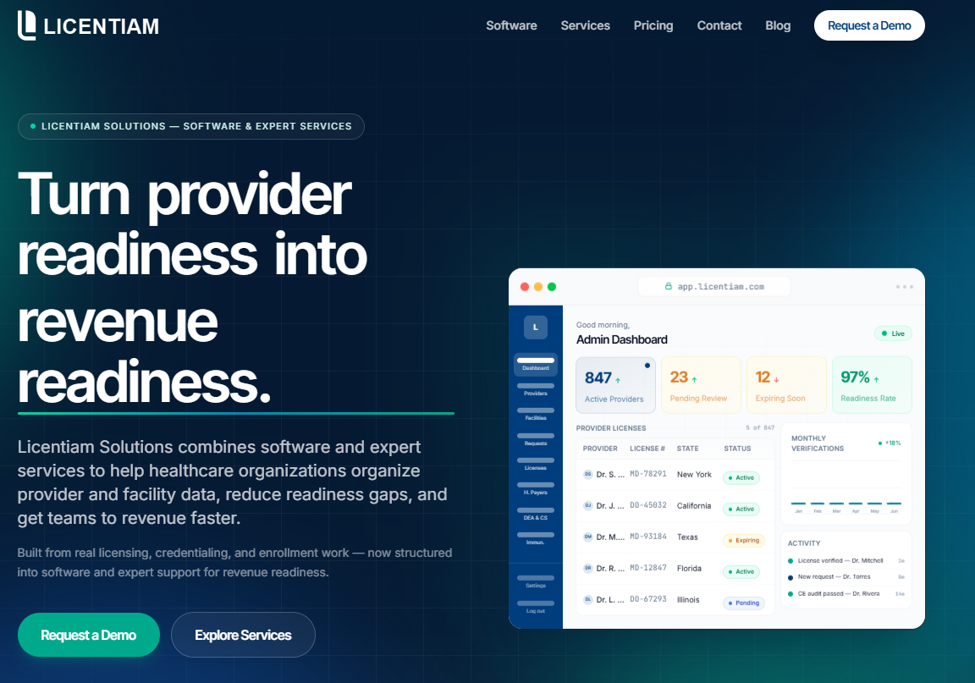
Licentiam helps healthcare organizations stay on top of regulatory compliance through configurable alerts and monitoring workflows.
Teams use Licentiam to identify compliance issues, such as expired licenses, privilege lapses, and missing training logs or policy attestations.
Licentiam also centralizes important documentation, including supporting claims, business associate agreements (BAA), and security logs, to stay organized for audits.
Beyond compliance support, Licentiam streamlines provider credentialing and licensing across all 50 U.S. states and territories.
It combines software and tech-enabled services, with AI-assisted automation capabilities being developed and rolled out in phases. Licentiam reduces manual work and reclaims 3,500+ administrative hours, unlocking more time for care delivery and revenue generation.
Schedule a demo today to see Licentiam’s platform and delivery model in action!
FAQs About Regulatory Compliance in Healthcare
What are the three main areas of healthcare compliance?
Healthcare compliance regulations fall into three key areas: patient safety, data privacy, and billing practices. They focus on preventing medical errors, safeguarding sensitive health information, and ensuring accurate coding and reimbursement processes.
What is an example of regulatory compliance?
An example of regulatory compliance is maintaining active healthcare provider licenses and credentials. Clinics and hospitals must verify education, training, and license status before allowing providers to deliver care. Ongoing monitoring and timely license renewals help healthcare organizations avoid service disruptions, denied reimbursements, or penalties.
What are the seven elements of healthcare compliance?
The seven elements of healthcare compliance are written policies, compliance leadership, staff training, communication lines, internal auditing, enforcement of standards, and corrective actions. They help healthcare organizations prevent, detect, and correct violations.
What is an example of a regulatory law in healthcare?
A popular healthcare law is the Health Insurance Portability and Accountability Act. HIPAA sets strict rules for how healthcare organizations store, share, and protect patient information. It applies to clinics, hospitals, and any group that handles patient health records.