
Credentialing is a key part of running a healthcare organization. If your clinic or hospital works with doctors, nurses, or other providers, you must confirm their licenses, education, training, and work history.
However, doing this task in-house can take a lot of time and manual effort. That is where CVO credentialing comes in.
It involves outsourcing credentialing and enrollment to a third-party organization. This approach helps you reduce delays, lower administrative workload, and keep provider records accurate.
This article covers the definition, purpose, and benefits of CVO credentialing. We’ll also discuss how it differs from in-house credentialing below.
Understanding CVO Credentialing
CVO credentialing is the process of having provider credentials verified by a Credentials Verification Organization (CVO) rather than your internal staff.
This process focuses on confirming key practitioner credentials, such as licenses, education, training, certifications, and work history. All provider data is reviewed against primary sources, such as licensing boards, medical schools, and past employers, to ensure accuracy.
Healthcare organizations that manage multiple providers often rely on CVOs to simplify credentialing and licensure processes.
Hospitals, clinics, and medical group practices commonly require CVO services to reduce the time and effort spent on in-house credentialing. Payers and networks also count on CVOs to handle credential verification processes.
What Is a Credentials Verification Organization?
A Credentials Verification Organization is a third-party entity that verifies provider credentials on behalf of your hospital or clinic.
A reputable CVO follows specific requirements set by the National Committee for Quality Assurance (NCQA) and URAC (formerly the Utilization Review Accreditation Commission).
A CVO also works with The Joint Commission (TJC) to meet strict industry standards for patient safety and accreditation.
The Purpose of a CVO
CVOs act as the extension of your internal credentialing team. They centralize data collection and conduct primary source verification. This helps your healthcare organization maintain compliance and simplify provider onboarding.
In addition to verifying provider credentials, CVOs provide ongoing monitoring for licenses, sanctions, and disciplinary actions. They also support payer enrollment to enable reimbursement.
CVOs accept delegated credentialing tasks to confirm a healthcare provider’s background, identify gaps or red flags in applications, and report the findings.
Many organizations in the healthcare industry hire CVOs to handle the credentialing process quickly, consistently, and in compliance with regulatory requirements. They typically lack in-house expertise, so they rely on CVOs to handle the administrative burden.
7 Key Benefits of CVO Credentialing
Below are the advantages of hiring CVOs for medical credentialing:
1. Increased Efficiency
With CVO credentialing, your internal staff no longer carries the full load of provider verification. A CVO acts as a specialized partner that manages credentialing for your organization.
They typically have established processes that shorten processing times and reduce back-and-forth work.
Your internal team can focus on higher-value duties instead of chasing missing documents.
2. Improved Accuracy and Consistency
CVO credentialing keeps provider records complete and consistent within your healthcare organization.
When credential data follows a single standard, errors and gaps appear less often. This supports strong data integrity across licenses, education records, and work history.
You no longer need to track the same details in different files or systems. You’ll also find it easier to conduct audits or internal checks since documents are accessible.
Plus, you can ensure patient safety, knowing that thorough checks have been made on the provider’s licenses, sanctions, and malpractice history.
3. Enhanced Regulatory Compliance
CVOs adhere to compliance standards when verifying credentials and enrolling providers in health plans.
These help your organization maintain compliance and avoid costly penalties. They also support risk mitigation, which enhances your company’s reputation in the healthcare industry.
4. Faster Provider Onboarding
CVO credentialing helps shorten onboarding timelines by keeping credential data organized and ready for review. This allows healthcare professionals to begin seeing patients sooner.
Faster onboarding also helps departments plan staffing with more certainty. When new providers enter practice without long waits, your organization benefits from smoother scheduling and fewer service gaps.
This advantage becomes more noticeable as your organization’s hiring volume increases.
5. Cost Savings
Internal credential management often requires more staff hours, overtime, or temporary help.
CVO credentialing minimizes operating costs by shifting verification work outside your organization. It also lowers the chance of rework caused by missing or outdated files.
Over time, fewer corrections and delays help control spending tied to provider credentialing tasks.
6. Accelerated Time to Revenue
When credential checks move faster, healthcare professionals can start billing sooner.
CVOs reduce delays tied to missing documents or repeated reviews. Shorter approval timelines mean fewer lost days between hire and active status. That directly improves cash flow for hospitals and clinics.
Revenue cycles also become more stable when provider start dates match staffing plans. These support stronger financial planning.
7. Scalability
As your healthcare organization grows, the manual work spent on credentialing can overwhelm your internal staff. This leads to delays and inconsistencies.
Fortunately, CVO credentialing supports expansion without hiring large internal teams.
Whether you open new locations or add service lines, verified processes stay consistent. This makes growth easier to manage when dealing with multiple departments and regions.
Scalable credential support also helps leadership plan long-term hiring goals with fewer operational limits tied to staff capacity.
Who Regulates and Accredits CVOs?
The NCQA is the primary body that accredits Credentials Verification Organizations in the United States. NCQA certification confirms that CVOs meet high standards for credentialing operations, data security, and continuous improvement.
URAC also plays a role by accrediting CVOs that perform credentialing and provider data functions, mainly for health plans, network management, and other related services.
Although TJC does not accredit CVOs, it influences credentialing operations. It allows hospitals and health systems to delegate provider verification tasks to a CVO.
CVO Credentialing vs. In-House Credentialing
If you’re still unsure how CVO credentialing differs from the traditional verification method, here’s a brief breakdown:
Ownership and Management
With in-house credentialing, your healthcare organization manages every part of the process, from data collection to final approval. This requires direct oversight, internal policies, and daily staff involvement.
Under CVO credentialing, verification tasks move to an outside entity, while your organization keeps decision authority. You still approve providers, but you rely on verified records reviewed by a specialized partner instead of running each check yourself.
Time and Cost Efficiency
In-house credentialing often takes longer due to staff limits, competing priorities, and manual follow-ups. These delays can increase labor costs and slow down provider onboarding.
Meanwhile, CVO credentialing shortens review cycles because a third-party organization focuses on these tasks alone and already has established processes. CVOs reduce back-and-forth emails, which can significantly save time and effort.
Faster turnaround means lower indirect costs tied to delays, such as postponed start dates and billing gaps that can affect regulatory compliance.
Staffing Requirements and Admin Workload
Internal credentialing depends heavily on trained staff who handle document requests, on-site reviews, primary source verifications, and record updates. Turnover or absences can create backlogs due to limited human resources.
CVO credentialing reduces pressure on internal teams by moving routine checks off-site. Your staff can focus on oversight rather than daily verification tasks.
This shift allows for better patient care and stronger relationships with payers and regulators.
Risk Management
In-house credentialing places full responsibility for errors, gaps, and missed updates on your organization. Missed items may surface during audits or on-site reviews.
With CVO credentialing, verification follows set review standards that reduce errors. While your organization retains final accountability, hiring an external partner lowers exposure tied to incomplete records and inconsistent documentation.
Use CVOs With Licentiam to Simplify Credentialing Processes
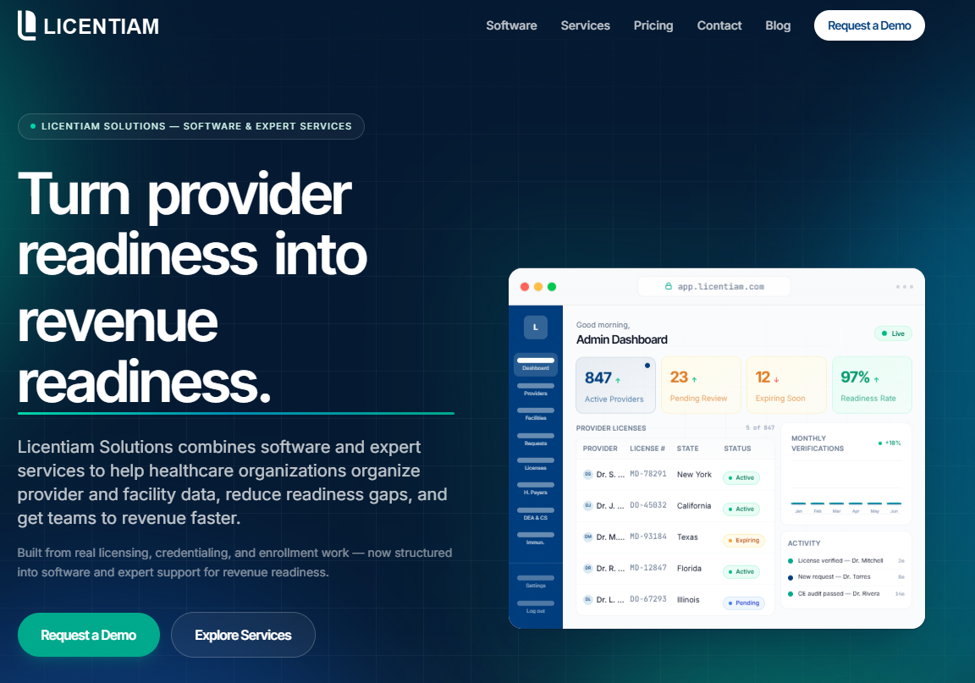
Licentiam works alongside CVOs to manage licensing and credentialing records for different provider types (e.g., MDs, DOs, NPs, RNs).
While a CVO completes primary source checks, Licentiam stores verified data, tracks license dates, flags expirations, and keeps documents organized in a centralized CRM and a secure repository.
Licentiam’s AI-assisted automation capabilities are also being developed and rolled out in phases to streamline provider onboarding, credential applications, and payer enrollment.
This approach helps clients avoid lost revenue (more than $200K per physician per month when credentialing is delayed) and save 20+ admin hours per provider on manual work.
With Licentiam, you can reallocate the time saved in administrative tasks to patient care and revenue generation. You can also maintain regulatory compliance, which enhances your company’s reputation.
Schedule a demo today to learn how Licentiam streamlines credentialing and improves your bottom line!
FAQs About CVO Credentialing
What does CVO mean in credentialing?
In credentialing, CVO refers to an outside group that verifies provider credentials for a healthcare organization. This includes checking licenses, education, and work history using original sources. The goal is to supply verified provider data that hospitals and clinics can rely on during their own review process.
What does CVO stand for in healthcare?
CVO stands for Credentials Verification Organization. In healthcare, it describes a third-party entity that performs credential checks on behalf of hospitals, clinics, and health systems.
Many organizations work with an NCQA-certified CVO because it meets the defined standards for reviewing and documenting provider information.
What is a CVO certificate?
A CVO certification usually refers to proof that a CVO meets formal review requirements, such as NCQA standards. It shows that the organization performing verification has been reviewed and approved to follow accepted credential verification practices.