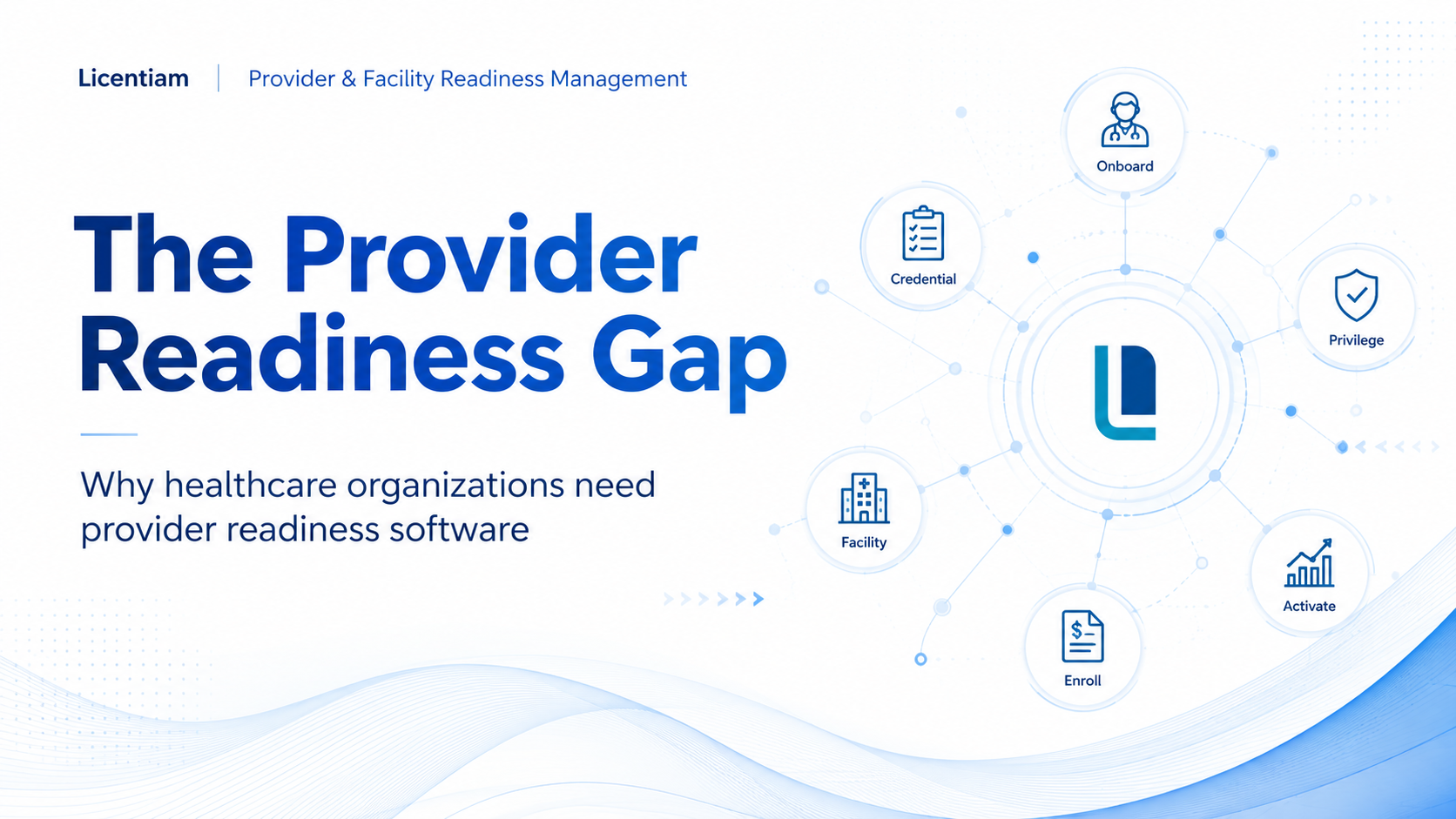
Executive thesis
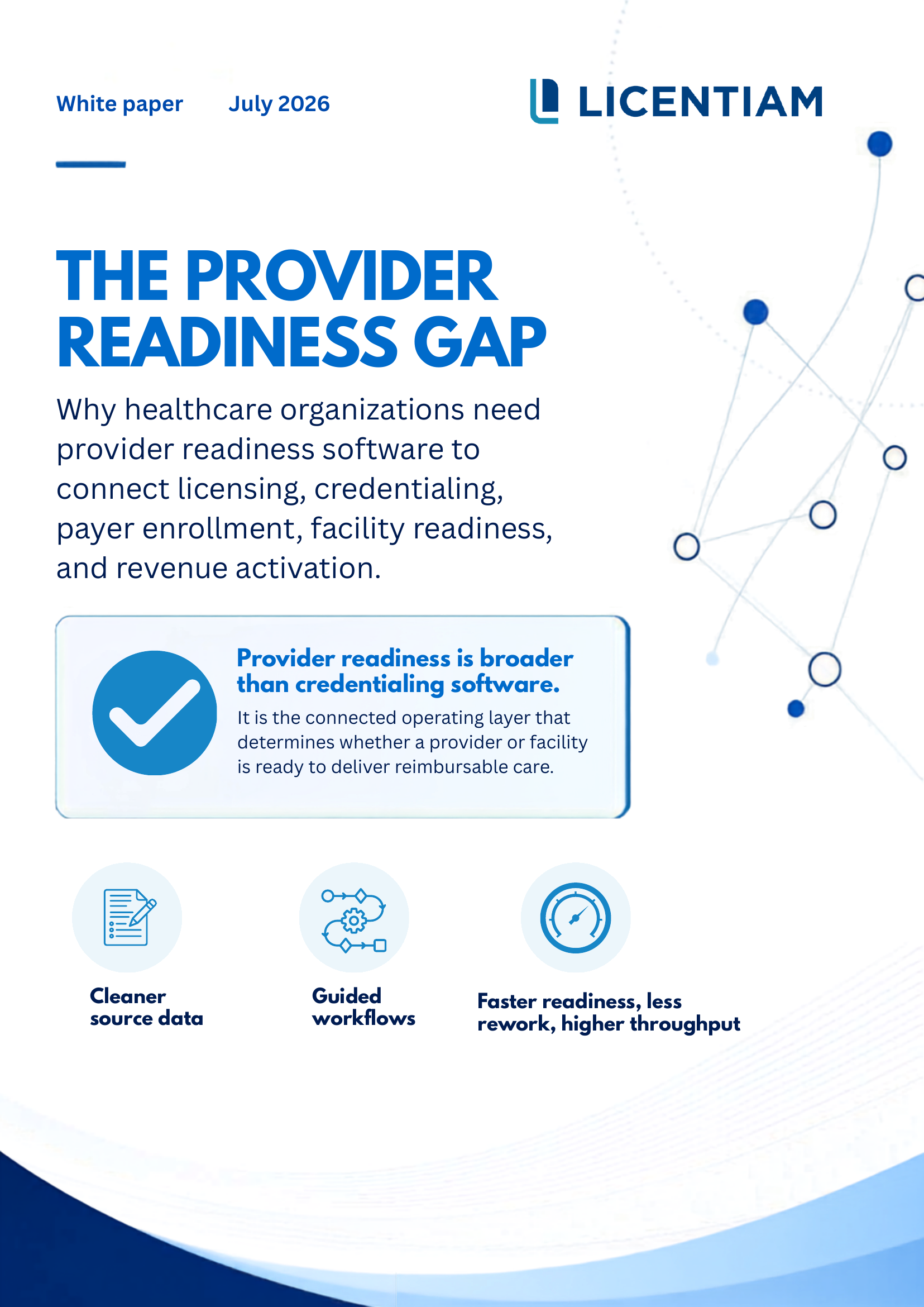
Provider readiness is broader than credentialing software. It is the connected operating layer that determines whether a provider or facility is ready to deliver reimbursable care. Healthcare organizations need provider readiness software built around a Provider & Facility Readiness Management platform that connects licensing, credentialing, payer enrollment, CAQH/DataSpring profile management, documents, expirables, monitoring, facility readiness, and operational handoffs.
Cleaner source data + guided workflows = faster readiness, less rework, higher throughput.
Executive summary
Healthcare organizations have spent years investing in provider credentialing software, payer enrollment processes, HR systems, document repositories, spreadsheets, and compliance workflows. Yet for many organizations, one of the most important operational questions remains difficult to answer:
Is this provider, facility, or care site actually ready to deliver reimbursable care?
That question is broader than credentialing. It is the problem provider readiness software must solve across professional licensure, payer enrollment, facility readiness, source-verified provider data, required documents, expirables, sanctions and exclusions monitoring, continuing education, provider onboarding, and cross-functional handoffs between HR, operations, credentialing, compliance, and revenue cycle teams.
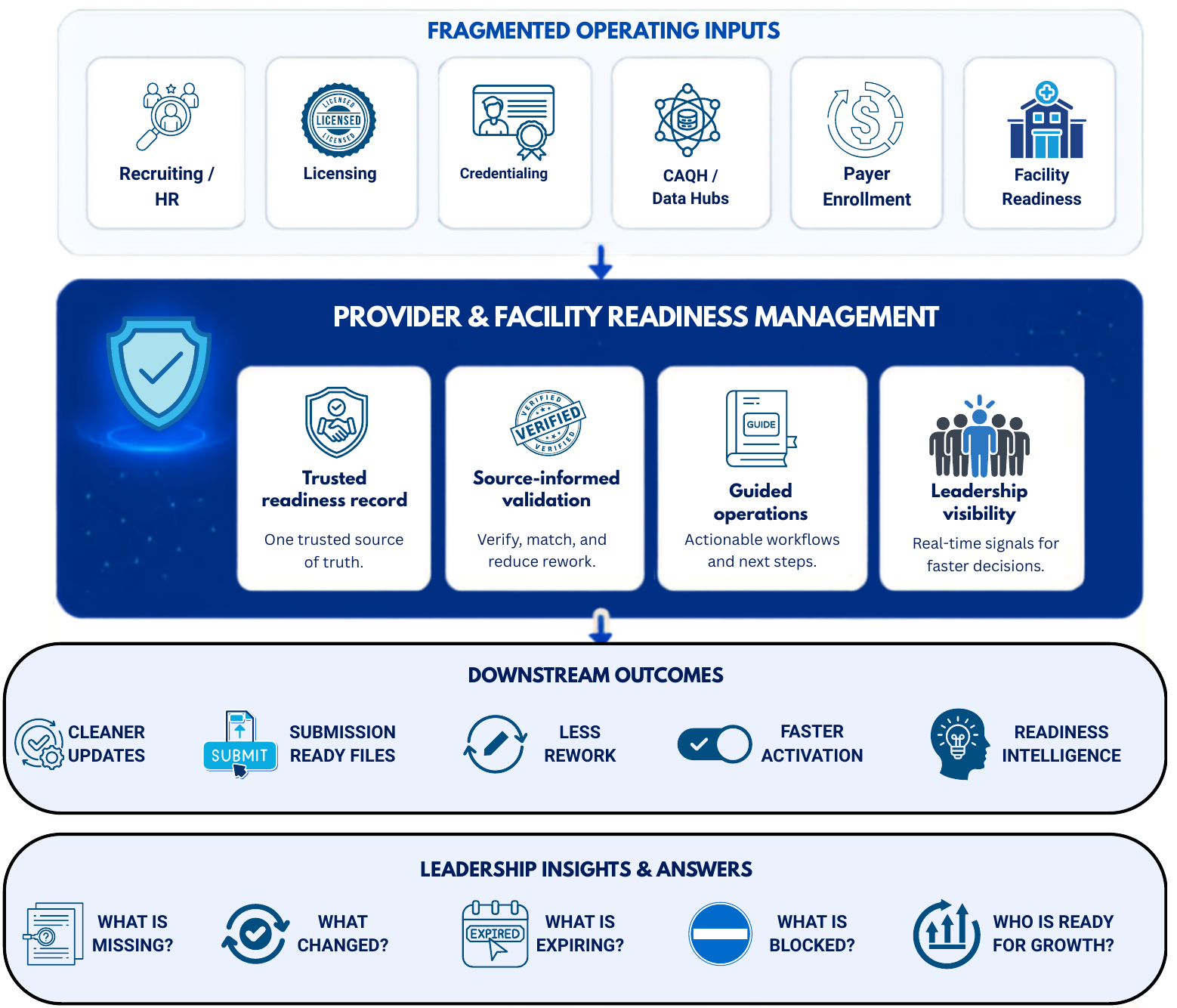
When those elements are tracked across disconnected systems, email threads, portals, spreadsheets, and individual staff knowledge, healthcare organizations experience what Licentiam calls the Provider Readiness Gap — the operational problem that sits between provider onboarding, healthcare credentialing software, payer enrollment software, Council for Affordable Quality Healthcare (CAQH) profile management, and revenue activation.
Definition
The Provider Readiness Gap is the distance between hiring, contracting, or expanding a provider network and having that network fully ready to deliver care, bill payers, maintain accurate records, and scale without avoidable administrative drag.
This gap matters because the healthcare system is under pressure from both sides. The Association of American Medical Colleges projects a U.S. physician shortage of up to 86,000 physicians by 2036, making every delay in deploying clinical capacity more consequential. CAQH/DataSpring also found that U.S. healthcare avoided an estimated $258 billion in administrative costs in 2024 through electronic transactions and improved data exchange, while still leaving a $21 billion additional savings opportunity through broader automation.
For small and mid-market healthcare organizations, the readiness problem is especially acute. These organizations often lack the large internal teams, enterprise implementation budgets, and dedicated support infrastructure of major health systems, yet they face the same underlying complexity: multi-state licensure, payer-specific requirements, changing provider data, facility licensing obligations, credentialing timelines, expirables, monitoring requirements, and reimbursement dependencies. They may evaluate provider credentialing software, payer enrollment software, provider onboarding software, license tracking tools, or provider data management systems separately, but the real operating need is a connected readiness view.
Licentiam’s perspective is grounded in eight years of hands-on services execution across healthcare licensing, credentialing, and payer enrollment. During that time, we developed readiness workflows to navigate and standardize more than 3,000 regulatory and payer pathways across all 50 U.S. states, territories, and private and government payer environments.
That experience has shaped a clear point of view: the next generation of healthcare operations will not be defined by who stores the most provider records. It will be defined by who can turn provider and facility data into actionable readiness intelligence.
8 years
Hands-on licensing, credentialing, and payer enrollment execution
3,000+
Regulatory and payer pathways standardized
50-state
States, territories, and payer environments
Free White Paper
Request the full white paper
Complete the form and we will send a copy of the Provider Readiness Gap white paper to the email address provided.
The problem: healthcare teams need provider readiness, not just credentialing software
Credentialing is often treated as a discrete administrative function or a feature inside healthcare credentialing software. In reality, it sits inside a larger operating lifecycle that also includes provider onboarding, licensing, payer enrollment, CAQH profile management, facility readiness, and ongoing monitoring.
Before a provider can generate revenue, become billable, or expand access to care, multiple readiness questions need to be answered:
- Is the provider licensed in the right state?
- Is the license active and source-verified?
- Are there pending renewals, expirations, sanctions, exclusions, or continuing education requirements?
- Are payer enrollment applications complete, submitted, approved, or blocked?
- Are CAQH/DataSpring profiles, payer profiles, and provider data management records current?
- Are required documents collected, current, and organized?
- Are facility or site-level dependencies resolved?
- Has the provider been cleared for the right services, payers, locations, and effective dates?
- Can leadership see what is ready, nearly ready, delayed, or blocked?
Most organizations can answer these questions eventually. The problem is that answering them often requires manual follow-up across people, systems, portals, and documents.
That is the Provider Readiness Gap. It is not simply a lack of software. It is a lack of connected provider readiness software and operational visibility across the systems that determine whether a provider or facility is ready to deliver reimbursable care.
Why the Provider Readiness Gap persists
The Provider Readiness Gap persists because the underlying work is fragmented across multiple functions.
Human resources may own hiring and provider onboarding. Credentialing teams may own provider files, verifications, payer applications, and CAQH/DataSpring maintenance. Operations teams may own launch timelines, site readiness, and provider deployment. Finance and revenue cycle teams may care about billable start dates, payer effective dates, and reimbursement delays. Compliance or quality teams may monitor exclusions, expirables, sanctions, and documentation.
Each function may be doing its job. But the organization still lacks a single readiness view.
Evidence matrix: why the Provider Readiness Gap persists
| Gap driver | Supporting evidence | Operational impact |
|---|---|---|
| Provider data lives in too many places | CAQH found that physician practices manage an average of 20.2 health plan contracts and spend at least one full staff day per week on provider directory maintenance, at an average cost of $998.84 per month per practice. (Source 3) | Provider data maintenance is a recurring operational burden that creates rework, repeated data requests, and version-control risk. |
| Readiness depends on external sources | Licenses, sanctions, exclusions, board actions, payer participation, facility status, and enrollment milestones often sit outside internal records and depend on state, payer, portal, and primary-source workflows. (Source 4) | Internal systems alone cannot confirm whether a provider or facility is ready to deliver reimbursable care. |
| Credentialing timelines delay activation | MGMA states that the time between provider application submission and credential verification or approval can take 90 to 180 days. (Source 5) | Credentialing delays extend time-to-billable, delay provider activation, and slow revenue capture. |
| Downstream data quality reflects upstream gaps | CMS previously found that 48.74% of Medicare Advantage provider directory locations reviewed had at least one inaccuracy. (Source 6) | Bad upstream data creates downstream payer, directory, patient-access, and network-integrity friction. |
| Readiness is continuous, not episodic | NCQA credentialing guidance emphasizes more current verification data and faster practitioner enrollment into networks. (Source 7) | Readiness must be monitored over time rather than treated as a one-time onboarding or file-building event. |
Gap driver
Provider data lives in too many places
Supporting evidence
CAQH found that physician practices manage an average of 20.2 health plan contracts and spend at least one full staff day per week on provider directory maintenance, at an average cost of $998.84 per month per practice. (Source 3)
Operational impact
Provider data maintenance is a recurring operational burden that creates rework, repeated data requests, and version-control risk.
Gap driver
Readiness depends on external sources
Supporting evidence
Licenses, sanctions, exclusions, board actions, payer participation, facility status, and enrollment milestones often sit outside internal records and depend on state, payer, portal, and primary-source workflows. (Source 4)
Operational impact
Internal systems alone cannot confirm whether a provider or facility is ready to deliver reimbursable care.
Gap driver
Credentialing timelines delay activation
Supporting evidence
MGMA states that the time between provider application submission and credential verification or approval can take 90 to 180 days. (Source 5)
Operational impact
Credentialing delays extend time-to-billable, delay provider activation, and slow revenue capture.
Gap driver
Downstream data quality reflects upstream gaps
Supporting evidence
CMS previously found that 48.74% of Medicare Advantage provider directory locations reviewed had at least one inaccuracy. (Source 6)
Operational impact
Bad upstream data creates downstream payer, directory, patient-access, and network-integrity friction.
Gap driver
Readiness is continuous, not episodic
Supporting evidence
NCQA credentialing guidance emphasizes more current verification data and faster practitioner enrollment into networks. (Source 7)
Operational impact
Readiness must be monitored over time rather than treated as a one-time onboarding or file-building event.
The evidence matrix summarizes the core drivers of the Provider Readiness Gap and the evidence behind each driver. The sections below expand on each point.
1. Provider data lives in too many places
Provider information is often stored in HR systems, spreadsheets, healthcare credentialing software, payer portals, CAQH/DataSpring, state licensing portals, license tracking tools, shared drives, email attachments, and individual staff notes. That creates provider data management and version-control problems, making it difficult to know which data is current, complete, or source-verified.
The burden of maintaining provider data is not theoretical. CAQH found that physician practices manage an average of 20.2 health plan contracts and must respond to directory-related requests through varying schedules, formats, and technologies. CAQH also found that practices spend at least one full staff day per week on provider directory maintenance, at an average cost of $998.84 per month per practice.
Directory maintenance is only one downstream symptom. The root cause is upstream provider data fragmentation. The same information may begin in an applicant tracking system or provider onboarding software, move into a credentialing platform, get re-entered into CAQH/DataSpring, appear again in a payer enrollment portal, and then require separate monitoring for expirations, sanctions, or internal compliance checks. Every handoff creates the possibility of delay, duplication, or error.
Bad data in, bad data out
If provider data is incomplete, stale, inconsistent, or not source-verified before it reaches downstream credentialing and enrollment workflows, those workflows inherit the problem. AI form-filling, provider credentialing software, and payer enrollment software cannot solve the problem if the underlying provider record is unreliable. In fact, automation can make the problem worse if it simply moves bad data faster.
2. Readiness depends on external sources
Provider readiness cannot be determined solely from internal records. Licenses, sanctions, exclusions, board actions, payer participation, facility status, and enrollment milestones often depend on external systems, third-party portals, and primary source verification workflows.
This is especially difficult in a state-based licensing environment. Each state and territory maintains its own regulatory structure for medical practice, and state-specific licensing requirements, renewal cycles, terminology, documentation expectations, and source systems can vary substantially.
The more an organization expands geographically, the more readiness becomes a source-validation, provider data management, and license tracking problem.
3. Credentialing timelines delay operational activation
Provider organizations need more than accurate provider data. They need providers to become operationally ready and billable as quickly as possible.
MGMA states that the time between provider application submission and credential verification or approval can take 90 to 180 days. MGMA also cites direct credentialing costs, outsourced enrollment fees, monthly credentialing fees, and the cost of hiring in-house credentialing specialists as part of the broader financial burden.
A provider who is hired but not ready is not simply an administrative issue. That provider may represent unused capacity, delayed revenue activation, delayed patient access, and additional burden on internal teams.
4. Downstream data quality problems reflect upstream workflow gaps
Provider directory inaccuracies are often discussed as a payer or directory problem. But inaccurate directories are frequently the downstream result of fragmented upstream workflows.
Centers for Medicare & Medicaid Services (CMS) previously found that 48.74% of Medicare Advantage provider directory locations reviewed had at least one inaccuracy, including incorrect location information, wrong phone numbers, or providers listed at locations where they did not actually practice or accept the plan.
Those errors matter because patients rely on provider directories to find care. When provider data is wrong, patients may waste time, encounter access barriers, or receive inaccurate information about network participation.
5. Readiness is continuous, not episodic
Many healthcare organizations treat provider readiness as an onboarding event. But readiness changes over time. Licenses expire. Providers change addresses. Continuing education requirements accumulate. Payer profiles become outdated. Facility relationships change. Sanctions or exclusions must be monitored. Documents age. Network participation changes. State and payer requirements evolve.
The 2025 National Committee for Quality Assurance (NCQA) credentialing guidance reflects this movement toward timelier data. NCQA explains that its verification timeframes are designed to help organizations access and work with more current data and get practitioners enrolled into networks faster.
This creates a clear operational mandate: provider readiness cannot be handled as a one-time file-building exercise. It must be managed as a continuous workflow supported by provider readiness software, license tracking, monitoring, and structured provider data management.
What Licentiam has observed in the market
Licentiam’s experience supporting healthcare organizations with licensing, credentialing, payer enrollment, provider data management, and facility readiness has shown that readiness gaps rarely come from a single broken tool.
More often, the problem is that provider data, documents, tasks, and accountability are spread across disconnected operating layers.
Those engagements have surfaced recurring blockers:
- Provider information begins outside the credentialing workflow.
- Licensing and credentialing teams work from different versions of provider data.
- CAQH/DataSpring profile management may not reflect current, verified information.
- Documents are collected but not structured for reuse across workflows.
- Expirables are tracked reactively instead of proactively.
- Facility dependencies are often separate from provider-level tracking.
- Compliance monitoring may sit in a different system or department.
- Payer follow-up depends heavily on manual status checks and individual staff knowledge.
- Operational leaders lack a real-time view of what is ready, nearly ready, delayed, or blocked.
The result is more manual work and a higher likelihood that bad or stale data will move downstream into credentialing, payer enrollment, provider directories, CAQH/DataSpring profiles, and reimbursement workflows.
That is why Licentiam’s technology strategy begins upstream: with cleaner, source-informed provider and facility data before downstream workflows begin.
1. Create cleaner source data
Build a trusted readiness record before downstream workflows begin.
2. Reuse the record across workflows
Use provider and facility data across licensing, credentialing, payer enrollment, monitoring, and facility readiness.
Multi-state provider vignette
A recent Licentiam discussion with a multi-state, residential-based healthcare organization highlighted the Provider Readiness Gap in practical terms.
The organization delivered primary care, behavioral health, care coordination, and services for high-needs patients across multiple markets. Its growth depended on the ability to acquire, onboard, license, credential, enroll, and activate enough providers to support services in each state.
No one tool was necessarily broken. HR used an applicant tracking system. Credentialing work was managed in a separate platform. Compliance checks were handled separately. Facility-related items and payer enrollment workflows were not fully integrated. Each team had tools that worked for its own function, but no team owned the full provider readiness lifecycle.
As a result, provider data moved from HR to credentialing to payer follow-up to compliance monitoring through fragmented handoffs. When information changed, teams had to determine where the update belonged, which system controlled the truth, and whether downstream workflows had been refreshed.
The deeper issue was that fragmentation was not fully visible as a business constraint. From the top, the problem did not appear simply as a software issue or a credentialing backlog. It showed up as slower market expansion, difficulty standing up services in certain states, and an inability to activate enough providers to support the organization’s intended growth rate.
This is the problem a Provider & Facility Readiness Management platform is designed to solve: creating a shared readiness layer across HR, credentialing, licensing, compliance, revenue cycle, and operations so leadership can see what is complete, what is missing, what is expiring, what is blocked, and which downstream workflows are affected.
When readiness fragmentation is invisible, growth constraints are misdiagnosed.
Why CAQH/DataSpring profile management matters
CAQH/DataSpring profile management is among the clearest examples of why upstream provider data quality matters.
The CAQH Provider Data Portal allows clinicians and group administrators to enter provider information once and share it with authorized plans. DataSpring describes the portal as a way to reduce administrative burden and errors by allowing authorized data sharing across plans.
For many credentialing and payer enrollment workflows, CAQH/DataSpring is a critical data hub. But CAQH profile management is only as useful as the quality, completeness, and freshness of the provider information entered into it.
If provider demographics, licenses, practice locations, documents, attestations, or credential updates are incomplete or stale, downstream credentialing can slow down. Payers may request corrections, applications may be delayed, staff may need to re-key information, and teams may spend time chasing the same data repeatedly.
That is the bad-data problem in credentialing technology, payer enrollment software, and CAQH profile management.
Most AI form-filling tools break down because every payer portal is different, requirements change constantly, and the underlying provider data is often not verified, complete, or current. Automating the form does not solve the problem if the source data is unreliable.
Licentiam’s approach is different. Licentiam is building provider readiness software through a Provider & Facility Readiness Management platform that gives healthcare organizations a shared operating layer for provider and facility readiness. Within that platform, provider demographics, credentials, licenses, documents, expirables, and readiness status can be organized, maintained, and reused across downstream workflows.
From that trusted readiness layer, Licentiam can deploy integrations and AI-assisted agents to connect with the databases and portals where that data needs to go, including CAQH/DataSpring, payer portals, licensing workflows, primary source verification sources, and monitoring systems, with human-in-the-loop review when required.
This pattern is repeatable. Once the credentialing data fabric is in place, the same model can extend to other fragmented databases, payer portals, licensing boards, primary source verification sources, and compliance systems. Verified updates should not have to be manually re-keyed across every downstream destination. They should originate from a trusted readiness record and propagate through structured, reviewable workflows.
That is how Licentiam turns upstream readiness into downstream acceleration.
Operational cost of provider readiness gaps
Administrative labor: Teams spend time tracking down documents, checking portals, reconciling data, updating spreadsheets, following up on missing information, and answering the same provider onboarding, credentialing, and enrollment questions repeatedly.
Rework: Applications are delayed or kicked back when information is incomplete, stale, inconsistent, or not aligned with payer, state, or facility requirements.
Slower revenue activation: When providers are not licensed, credentialed, enrolled, documented, or cleared for the right payer and site combinations, organizations may be unable to bill for services as planned, extending the time from provider onboarding to billable care.
Operational uncertainty: Leaders may not have a real-time view of which providers are ready, nearly ready, blocked, or at risk of falling out of readiness.
Limited scalability: Organizations that depend on tribal knowledge and manual follow-up may be able to manage a small provider network, but growth strategies can fail as they add providers, states, facilities, payers, or service lines.
The cost is not only financial. It is strategic. Healthcare organizations that cannot quickly understand and activate their provider network are slower to expand, slower to open new markets, slower to capture reimbursement, and slower to deliver care. Provider readiness software should make activation bottlenecks visible before they become revenue delays.
From credentialing software to readiness intelligence
The solution is not simply another place to store provider information. Healthcare credentialing software, payer enrollment software, HR systems, and document repositories can all hold important data, but most healthcare organizations already have multiple places to store provider information.
The more important need is provider readiness software built around a Provider & Facility Readiness Management platform.
A Provider & Facility Readiness Management platform connects provider and facility information to the operational questions healthcare teams need to answer every day across provider credentialing, payer enrollment, license tracking, CAQH profile management, and facility readiness:
- What is missing?
- What has changed?
- What is expiring?
- What needs source verification?
- What is ready for submission?
- What is blocked?
- What can be escalated?
- Which providers or facilities are ready to support growth?
- Where is the organization exposed to preventable delay?
The shift
A provider database tells an organization what it has.
A Provider & Facility Readiness Management platform tells the organization what it can do next.
Provider readiness software should connect provider onboarding, healthcare credentialing, payer enrollment, license tracking, CAQH profile management, and monitoring into one operating view.
That shift is especially important for small and mid-market healthcare organizations. These organizations need the benefits of structured provider operations, provider data management, license tracking, payer enrollment visibility, and healthcare credentialing software workflows without the complexity, cost, and implementation burden of enterprise systems designed for large institutions.
What readiness should include
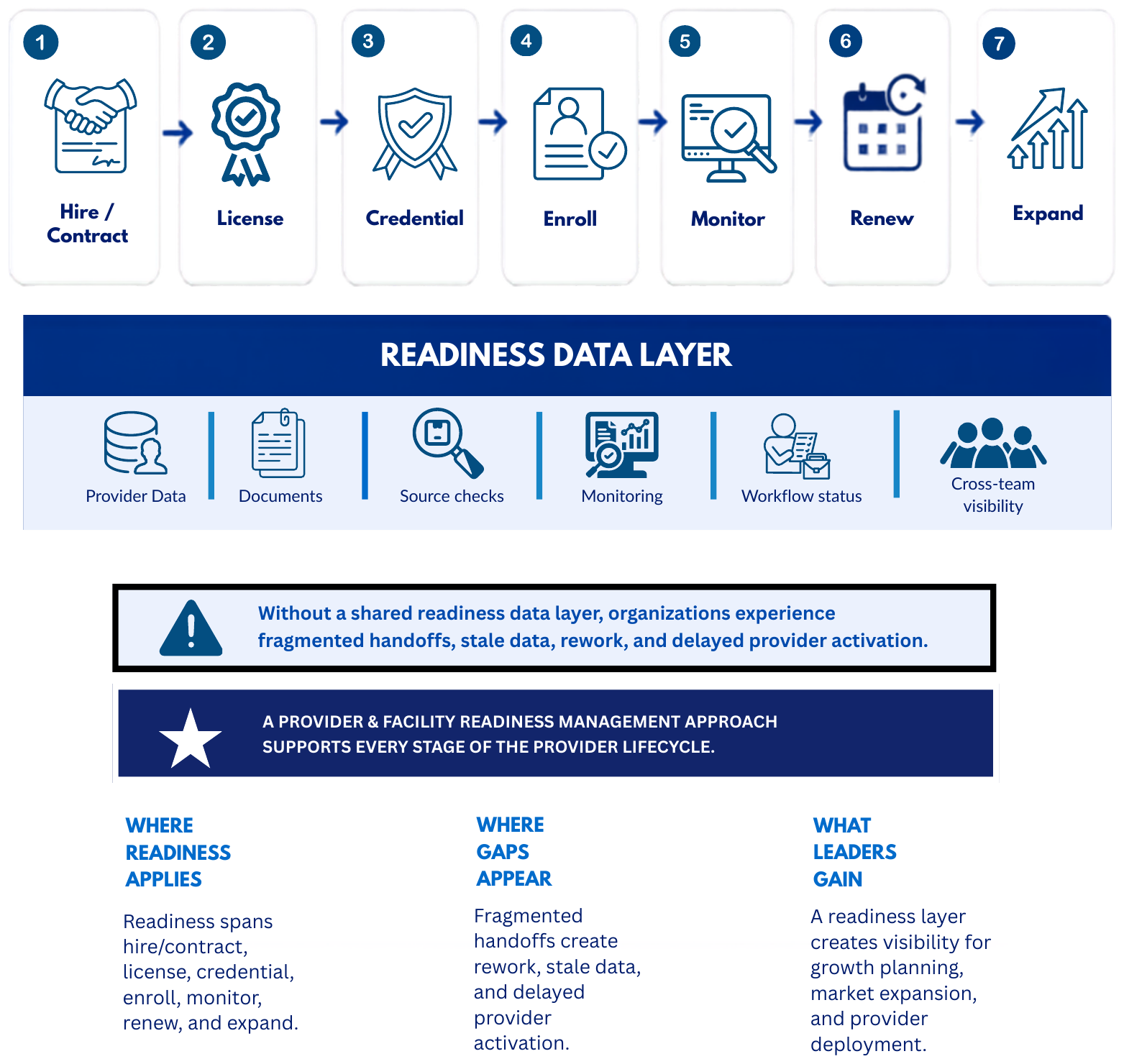
Comprehensive provider readiness software should support at least seven operational layers across provider and facility readiness.
Identity, provider profile, and data management readiness
The organization should maintain a complete, structured, and current provider profile, including demographics, identifiers, NPI and taxonomy details, specialties, locations, payer relationships, employment or contractor status, and required documentation.
Licensing and healthcare license tracking readiness
The organization should know whether each provider has the right active licenses for the states, services, and care models in which they are expected to operate. This includes healthcare license tracking, expiration tracking, renewal workflows, source validation, and state-specific requirements.
Provider credentialing and payer enrollment readiness
The organization should be able to track whether providers are prepared for credentialing, payer enrollment, recredentialing, delegated credentialing, or payer-specific submissions. Readiness should include application status, missing information, payer effective dates, submission dependencies, and blocked enrollment workflows.
CAQH/DataSpring profile management and data-hub readiness
Provider profiles should be maintained in a way that supports downstream data hubs such as CAQH/DataSpring. Accurate, current, source-verified provider data should be available before it is pushed into payer-facing workflows, CAQH profile management processes, and provider enrollment submissions.
Document and credential file readiness
Provider files should not depend on scattered attachments or shared-drive folders. Required documents should be collected, organized, current, and tied to the relevant workflow.
Expirable tracking and continuing education readiness
Licenses, certifications, insurance, CME, DEA registrations, board certifications, immunizations, and other expirables should be tracked proactively so teams are not surprised by lapses, renewal deadlines, or re-attestation requirements.
Monitoring, sanctions, and facility readiness
Organizations should monitor relevant sanctions, exclusions, disciplinary actions, license changes, and other risk signals as part of the ongoing provider lifecycle. Provider readiness should also account for facility credentialing, facility licensing, and site-level dependencies, especially for diagnostic labs, behavioral health organizations, home health, multi-site practices, and organizations expanding across jurisdictions.
How provider readiness should be measured
Healthcare organizations should begin treating provider readiness as a measurable operating capability rather than a back-office task. Effective provider readiness software should translate licensing, credentialing, payer enrollment, CAQH profile management, and facility readiness into measurable operating signals.
Licentiam’s current SaaS pilot framework is focused on pre-SaaS and early SaaS outcomes that can be measured before a customer has a fully mature automation program. Those outcomes include provider readiness visibility, document and credential access, expirable and renewal visibility, usefulness of AI-assisted extraction and checks, time and effort required to produce readiness summaries, actionable readiness reporting, and confidence for broader adoption of provider readiness software.
These metrics move teams from reactive follow-up to proactive management by showing where growth is moving, where it is blocked, and what needs attention across credentialing, payer enrollment, licensing, facility readiness, and provider activation.
Core readiness metrics
| Core readiness metric | Why it matters |
|---|---|
| Average days to submission-ready | Shows how quickly recruiting, licensing, document collection, and internal handoffs convert a provider into a complete, submission-ready file. |
| Average days to payer-effective or billable status | Connects readiness work directly to revenue activation and reveals where downstream payer steps create delays. |
| Number and percentage of blocked providers | Highlights providers delayed by payer, state, facility, or data dependencies so teams can prioritize remediation. |
| Readiness by state, payer, service line, and location | Gives leadership a portfolio view of growth capacity, operational risk, and where network expansion is ready or constrained. |
Core readiness metric
Average days to submission-ready
Why it matters
Shows how quickly recruiting, licensing, document collection, and internal handoffs convert a provider into a complete, submission-ready file.
Core readiness metric
Average days to payer-effective or billable status
Why it matters
Connects readiness work directly to revenue activation and reveals where downstream payer steps create delays.
Core readiness metric
Number and percentage of blocked providers
Why it matters
Highlights providers delayed by payer, state, facility, or data dependencies so teams can prioritize remediation.
Core readiness metric
Readiness by state, payer, service line, and location
Why it matters
Gives leadership a portfolio view of growth capacity, operational risk, and where network expansion is ready or constrained.
Additional measures include:
- Percentage of providers with complete and current profiles.
- Percentage of provider files with missing or expired documents.
- Number of licenses, certifications, or documents expiring within 30, 60, and 90 days.
- Administrative hours spent on manual follow-up and rework.
- Time required to produce a provider readiness summary or credentialing status report.
- Percentage of provider records with source-verified demographic and credential data.
- Revenue impact of delayed provider activation.
These provider readiness metrics allow leaders to move from reactive follow-up to proactive management. They also make readiness visible to the broader organization. Instead of asking credentialing or operations teams for manual status updates, executives can see where growth is moving, where it is blocked, and what needs attention across credentialing KPIs, payer enrollment metrics, and provider activation timelines.
Healthcare organizations can begin measuring readiness before they have a fully mature automation program. The first step is not complete automation. The first step is visibility across provider readiness metrics, credentialing KPIs, payer enrollment metrics, and expirable tracking.
A practical Provider Readiness Scorecard should help leadership, operations, credentialing, compliance, and revenue teams answer the same core question across provider onboarding, credentialing, payer enrollment, and facility readiness:
Which providers and facilities are ready, nearly ready, delayed, blocked, or at risk?
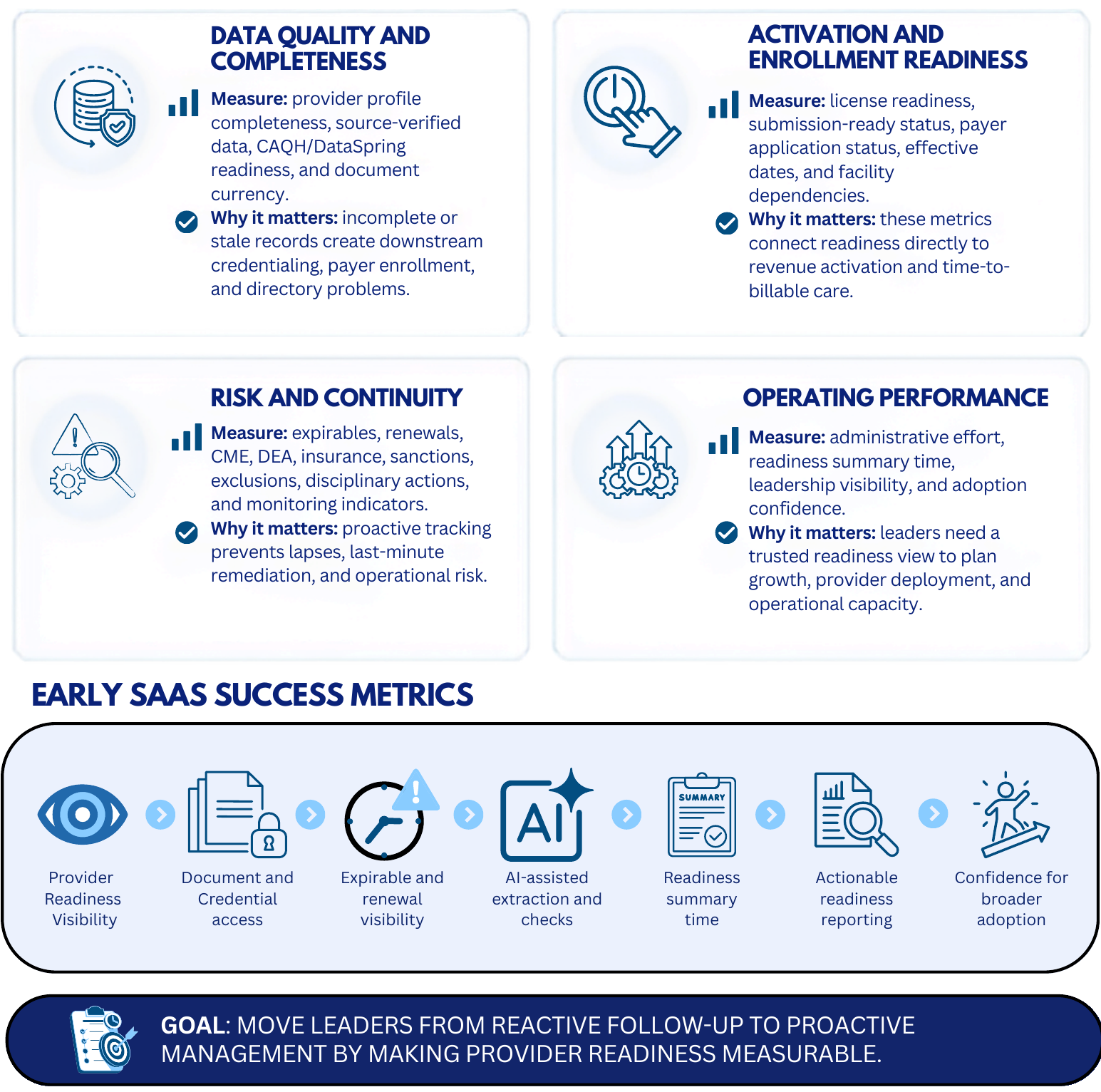
The goal of this scorecard is not to create another reporting burden. It is to make readiness measurable. Once readiness is measurable, teams can identify bottlenecks, reduce rework, improve handoffs, and create a clearer path from provider onboarding to reimbursable care delivery.
Why this matters now
Market expansion
Healthcare organizations are expanding across state lines through telehealth, multi-site growth, acquisitions, and distributed care models.
Administrative pressure
Teams are under pressure to do more with less, while manual workflows and portal checks become harder to sustain.
Current data requirements
Payers and accrediting bodies emphasize timelier data, primary source verification, CAQH profile management, and ongoing oversight.
Patient access
With workforce pressure and projected physician shortages, every avoidable delay in provider activation matters.
Together, these forces point to a clear conclusion: provider readiness is becoming a strategic operating capability and an emerging software category for healthcare organizations.
The Licentiam perspective
Licentiam believes healthcare organizations need provider readiness software built around a dedicated readiness layer for provider and facility operations.
This layer should help administrative teams centralize provider and facility data, validate information at the source where possible, manage documents and expirables, monitor ongoing readiness, support CAQH profile management, and convert complex licensing, credentialing, and payer enrollment knowledge into guided workflows.
The goal is not to replace administrative expertise. The goal is to make that expertise scalable.
For many organizations, the most experienced licensing or credentialing team members carry years of operational knowledge in their heads. That knowledge is valuable, but it is difficult to scale if it remains undocumented, manual, or dependent on individual staff members.
A readiness platform should help turn that knowledge into repeatable workflows so administrative teams can operate with greater consistency, visibility, and confidence across provider onboarding, healthcare credentialing, payer enrollment, license tracking, and facility readiness.
When provider readiness software is implemented well, the benefits extend across the organization:
- Operations teams can plan growth more reliably.
- Credentialing teams can reduce rework and manual tracking.
- Finance teams can better understand revenue activation timelines.
- Compliance and quality teams can monitor ongoing status more effectively.
- Providers can move through onboarding and expansion with less friction.
- Patients can gain access to care sooner.
Provider readiness is therefore not just an administrative function. It is a growth, revenue, and access-to-care function.
Free White Paper
Request the full white paper
Complete the form and we will send a copy of the Provider Readiness Gap white paper to the email address provided.
Conclusion
The Provider Readiness Gap exists because healthcare organizations are trying to manage a complex, continuous, source-dependent workflow with fragmented tools and manual processes across provider onboarding, licensing, credentialing, payer enrollment, CAQH profile management, and facility readiness.
Provider credentialing software, spreadsheets, document repositories, payer enrollment portals, HR systems, and email threads may each solve part of the problem. But none of them alone answers the question healthcare leaders increasingly need answered:
Who is ready to deliver care, where, for which payers, under which licenses, with which documentation, and what still needs to happen next?
That is the readiness question.
As healthcare organizations face workforce shortages, administrative cost pressure, payer complexity, multi-state expansion, and growing demands for accurate provider data, provider readiness software will become a core operating capability.
The organizations that manage readiness proactively will be better positioned to grow, activate providers faster, reduce administrative burden, protect revenue, and expand access to care.
The next generation of healthcare operations will be defined by who can turn provider and facility data into actionable readiness intelligence.
About Licentiam
Licentiam is building provider readiness software through a Provider & Facility Readiness Management platform for healthcare organizations that need better visibility across licensing, credentialing, payer enrollment, CAQH profile management, expirables, documents, monitoring, facility readiness, and operational workflows.
Built from years of hands-on experience supporting healthcare organizations through complex licensing, credentialing, payer enrollment, provider data management, and facility readiness work, Licentiam helps teams move from fragmented tracking to structured, source-informed readiness management.
Licentiam’s technology strategy begins upstream: create cleaner provider and facility data, validate it where possible, organize it into reusable workflows, and then use provider readiness software, integrations, and AI-assisted agents to reduce downstream rework across credentialing, payer enrollment, CAQH/DataSpring profile management, payer follow-up, and readiness reporting.
Frequently asked questions
What is provider readiness software?
Provider readiness software helps healthcare organizations understand whether providers, facilities, and care sites are ready to deliver reimbursable care. It connects licensing, credentialing, payer enrollment, CAQH/DataSpring profile management, documents, expirables, monitoring, facility readiness, and operational handoffs into a more visible readiness workflow.
How is provider readiness different from provider credentialing?
Provider credentialing is one part of the readiness lifecycle. Provider readiness is broader. It includes credentialing, professional licensing, payer enrollment, provider onboarding, CAQH profile management, facility readiness, expirables, sanctions and exclusions monitoring, documents, and revenue activation dependencies.
What is the Provider Readiness Gap?
The Provider Readiness Gap is the distance between hiring, contracting, or expanding a provider network and having that network fully ready to deliver care, bill payers, maintain accurate records, and scale without avoidable administrative drag.
Why does CAQH/DataSpring profile management matter for provider readiness?
CAQH/DataSpring profile management matters because many credentialing and payer enrollment workflows rely on accurate provider data. If provider demographics, licenses, practice locations, documents, attestations, or credential updates are incomplete or stale, downstream credentialing can slow down, payer corrections can increase, and administrative teams may be forced into re-keying and manual follow-up.
How should healthcare organizations measure provider readiness?
Healthcare organizations can measure provider readiness by tracking days from hire or contract to submission-ready status, days from submission-ready to payer-effective or billable status, percentage of complete provider profiles, percentage of source-verified provider records, expiring licenses or documents, blocked providers, administrative hours spent on rework, and readiness by state, payer, service line, facility, and location.
Who needs Provider & Facility Readiness Management software?
Provider & Facility Readiness Management software is especially useful for small and mid-market healthcare organizations, multi-state provider groups, behavioral health organizations, diagnostic labs, home health and hospice providers, telehealth companies, multi-site practices, and organizations expanding across states, payers, facilities, or service lines.
How can provider readiness software reduce credentialing and payer enrollment delays?
Provider readiness software can reduce delays by improving upstream data quality, organizing reusable documents, supporting source-informed validation, tracking expirables, guiding next steps, and giving leaders visibility into missing items, blocked workflows, and downstream enrollment dependencies before they become revenue delays.
Selected sources
- Association of American Medical Colleges — Addressing the Physician Workforce Shortage
- DataSpring, powered by CAQH — 2025 CAQH Index Shows U.S. Healthcare Avoided $258 Billion and Accelerated Automation, Interoperability, and AI Adoption
- CAQH — The Hidden Causes of Inaccurate Provider Directories
- Federation of State Medical Boards — Introduction to Medical Regulation in the United States
- Medical Group Management Association — Navigating the Credentialing Gauntlet
- Centers for Medicare & Medicaid Services — Online Provider Directory Review Report
- NCQA — A Comprehensive Guide to NCQA Credentialing Programs
- DataSpring, powered by CAQH — For Clinicians / CAQH Provider Data Portal