
When provider records sit in many places, credentialing teams repeat work, miss important dates, and face payment delays.
Centralized credentialing brings all provider information into one shared system. It creates a single source of truth to avoid data silos, reduce repetitive work, and improve revenue cycles.
This guide explains the definition and benefits of centralized credentialing. We’ll also share some tips on how to implement a centralized model successfully.
What Is Centralized Credentialing?
Centralized credentialing is a credentialing approach where all provider data is managed in a single shared system. This includes licenses, certifications, work history, provider qualifications, payer records, and compliance checks.
Instead of each department keeping its own files and doing its separate processes, providers submit applications once to a central team or platform. That means credentialing tasks follow a single set of rules and workflow.
The goal is to consolidate provider data used by different teams, locations, and systems, which can eliminate redundant efforts.
Top 6 Benefits of Centralized Credentialing
Healthcare organizations that have successfully implemented centralized credentialing services can benefit from the following:
1. Eliminate Redundant Tasks
When credentialing data is spread among different departments, the same work often happens more than once. A medical staff services (MSS) requests the same documents, rechecks the same licenses, and updates the same records in different systems.
Centralized credentialing reduces repetitive work and administrative burden by storing all provider data in one shared location.
An MSO no longer needs to ask healthcare providers for the same files repeatedly. They collect the necessary data upfront and keep it in one place to avoid back-and-forth communication.
This improves operational efficiency and frees up valuable time for more important tasks, such as care delivery or revenue generation.
2. Achieve Faster Provider Onboarding
Centralized credentialing creates a single source of truth, which can significantly speed up provider onboarding.
An MSO can track credentialing progress without searching through emails or paper files. They’ll also find it easy to spot missing items and request additional documents from healthcare providers to accelerate the verification process.
As a result, healthcare organizations see fewer administrative delays, while providers can begin seeing patients sooner.
3. Ensure Data Integrity
Credentialing errors often come from outdated or mismatched records. With multiple systems in use, it is difficult to know which version is correct.
A centralized system enables consistent and thorough verification of provider qualifications throughout the organization.
An MSS works with standardized data and follows the same review steps.
When the provider makes changes in their file, these updates sync and apply everywhere. The provider does not need to update their profile with each hospital or facility. They only need to do it once using the state’s provider network module.
This approach lowers the risk of missing expirations, incorrect details, or duplicate files. It also improves data accuracy, which supports billing, compliance reviews, and internal reporting without additional rework.
4. Enhance Provider Experience
Many providers view credentialing as an administrative burden, especially when they need to submit the same information to each hospital, clinic, or insurance company. They easily get frustrated when asked for the same details repeatedly.
Adopting centralized credentialing improves provider satisfaction and credentialing experience by reducing repetitive requests.
Network providers submit their information once and know it will be reused when needed. Important records, including provider education and licenses, stay linked to a single profile. This saves time and builds trust between providers and medical staff services (MSS).
Providers are also more willing to respond quickly and stay engaged during onboarding when they see organized credentialing and enrollment processes.
5. Lower Credentialing Costs
Labor expenses increase when credentialing teams repeat tasks or fix errors due to missing or inaccurate data.
Integrating centralized credentialing helps lower these costs by reducing wasted effort. It makes sure all provider data is accessible from a central system. That means fewer handoffs to track.
Medical staff services can handle more providers without adding extra headcount to help manage the workload.
A centralized model also lowers costs tied to security issues. With one platform, organizations can better protect sensitive provider information through enhanced data security measures and clearer oversight. Fewer systems even reduce exposure points and the risk of costly breaches.
6. Strengthen Regulatory Compliance
Healthcare organizations need to follow many rules from payers, states, and federal agencies, such as the Centers for Medicare and Medicaid Services (CMS) and the National Committee for Quality Assurance (NCQA).
Centralized credentialing supports ongoing compliance operations by keeping records organized and easy to review.
The medical staff office can quickly show proof of licenses, certifications, and approvals during external audits. They can also track expiration dates and renew credentials before regulators find out.
This proactive, coordinated approach ensures compliance with federal and state regulations. It makes audits less stressful and more predictable while simplifying Medicaid participation.
Tips for Implementing Centralized Credentialing
Here’s how to successfully adopt centralized credentialing in your healthcare organization.
Evaluate Your Current Credentialing Process
Before restructuring to a centralized model, you should assess how credentialing currently works in your company. List the steps, state and federal systems, and stakeholders involved.
You may be surprised to know that credentialing goes through different departments, and not just the MSO. Provider data can be passed between HR teams, hospital directors, payer contracts, and other credentialing agents.
Map out each department’s responsibilities to identify operational inefficiencies, overlaps, and weak points.
You should also ask what provider data each team collects and what systems they use to store it. Doing so uncovers opportunities where you can consolidate credentialing tasks and avoid redundancy.
Standardize Credentialing Policies and Procedures
Once you’ve reviewed current workflows, you can integrate centralized credentialing with your existing provider screening and enrollment processes.
Set clear policies for what documents are required during application intake, how often checks happen, and who approves each step.
Standardized provider credentialing modules help new team members follow the same process without guesswork. These reduce confusion and maintain uniform credentialing standards, even when your organization grows.
Choose the Right Provider Credentialing Software
Technology plays a key role in centralized credentialing.
Choose credentialing software that supports modernized provider verification through automated and standardized processes rather than manual tracking.
Look for a platform that stores all provider data in one place, tracks application status, and flags missing items. All information should follow the same format and sync across departments and locations to ensure data standardization.
The right system also reduces manual follow-ups by collecting primary source verifications directly from licensing boards, schools, and certifying bodies.
Through rigorous and centralized screening, credentialing software confirms that network providers meet the requirements to deliver safe and effective patient care.
Define Ownership and Train Medical Staff
Centralized credentialing needs clear ownership to work properly. Assign who manages data, who reviews files, and who handles updates. Without clear roles, tasks can stall.
Training is just as important. Staff should know how to enter data, review records, and handle exceptions.
When teams understand the entire process, centralized credentialing offers assurance that work is done the same way every time. This leads to more reliable credentialing outcomes.
Monitor and Optimize Workflows
After rollout, ongoing review keeps centralized credentialing on track. Monitor timelines, error rates, and open tasks so small issues do not turn into larger problems.
Clear reporting helps teams identify errors early and take action before they affect onboarding or renewals.
You should also consider conducting monthly validations to confirm that records stay current and complete. These reviews make sure that only qualified providers maintain clinical privileges and that expired items are flagged in time.
Regular check-ins also make it easier to answer provider concerns about re-credentialing status or missing documents.
Enjoy the Benefits of Centralized Credentialing With Licentiam
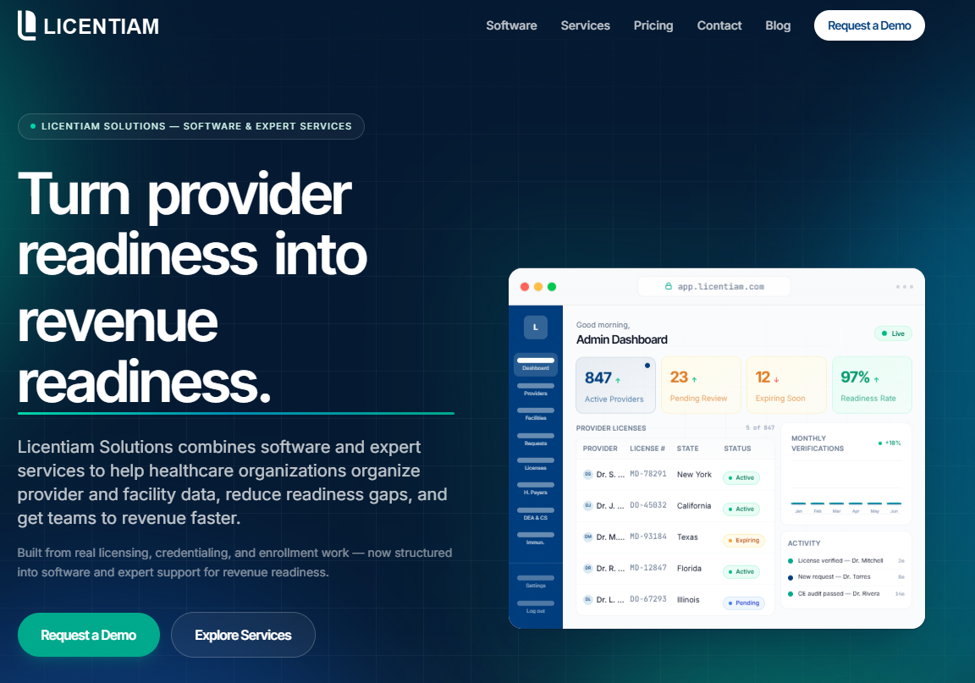
Licentiam is a CRM platform and tech-enabled services partner that centralizes documents, tasks, reminders, and audit-ready reporting.
With Licentiam, healthcare organizations eliminate the need for spreadsheets, email, and fragmented tools. It provides a secure document repository to streamline provider licensing, credentialing, and payer enrollment workflows in all 50 states and U.S. territories.
Licentiam also supports ongoing compliance with configurable reminders and continuous monitoring workflows, which help teams identify issues early and stay audit-ready.
Plus, AI-assisted automation capabilities are being developed and rolled out in phases to reduce manual and redundant steps, ensure consistency, and accelerate time to revenue.
Book a demo today to see how Licentiam centralizes credentialing and reduces administrative burden.
FAQs About Centralized Credentialing
What is centralized credentialing?
Centralized credentialing is a method where all provider records and existing data are managed in one shared system. Healthcare organizations rely on one process to manage provider files instead of maintaining separate records in multiple locations.
What are common credentialing mistakes?
Common credentialing errors include missing license renewals, storing records in many systems, and asking providers for the same information multiple times. These issues often lead to delays and weaken oversight. A centralized credentialing approach reduces these mistakes by keeping records accurate and easier to review.
What is the difference between a credentials verification organization (CVO) and credentialing?
Credentialing is the full process of reviewing and approving providers to deliver care. It is usually completed by an organization’s medical staff office.
A Credentials Verification Organization (CVO) only handles the verification of provider information on behalf of hospitals, clinics, and other entities. The healthcare organization still makes the final approval decision.