
Hospitals, clinics, or group practices should confirm that every provider meets licensing rules before patient care begins.
If a license is missing, expired, or not valid for a provider’s role, both care delivery and billing can be put at risk.
Organizations are responsible for checking that healthcare providers are approved by the correct state boards and agencies.
This guide explains the definition and importance of provider licensing. We’ll also discuss the step-by-step process of how it works.
What Is Provider Licensing?
Provider licensing is the process of confirming that a medical provider holds a valid, active license issued by the proper authority. These licenses are granted by state boards and, in some cases, are required under federal law.
Medical licensure shows that a healthcare practitioner has complied with education, training, and legal standards to deliver patient care.
The provider licensing process applies to many roles across an organization. This includes physicians, nurses, therapists, and other allied health professionals.
The Importance of Provider Licensing
It is important to validate each provider’s licenses before granting them clinical privileges and initiating payer enrollment. Here are the reasons why:
- Ensure compliance: Provider licensing helps you meet state laws and federal rules tied to patient care and billing. Missing or invalid licenses can lead to audits, fines, and service limits that disrupt daily operations.
- Improve safety and patient outcomes: Licensing confirms that providers completed initial licensure and meet training standards. This helps your organization reduce the risk of medical errors and patient harm.
- Accelerate provider onboarding: A clear licensing process allows you to verify healthcare providers faster. Fewer delays mean practitioners can begin seeing patients sooner and support staffing needs.
- Avoid late payments: Licenses affect payer approval and claims processing. If provider records are incomplete, reimbursements may be delayed or denied, which can affect cash flow.
- Protect organizational reputation: Failure to comply with licensing rules can damage trust with patients, payers, and regulators. Strong oversight shows that your organization follows regulatory standards.
How Does Provider Licensing Work?
Provider licensing follows a structured process that healthcare organizations should manage from start to finish.
1. Identify State Requirements for Each Provider
Start by reviewing licensing rules based on where the patients receive care, not where the provider lives. Requirements can vary across different states, even for the same role or specialty.
Some states are part of licensing compacts, while others are not. Compact states (e.g., Florida, Texas) allow providers to apply for licenses in multiple member states through a shared framework.
However, non-compact states (e.g., California, New York) require separate, state-specific applications, even if a provider holds the same license in another state.
If providers will treat patients across state lines, you need to carefully review each state’s regulations to make sure everything is in order. This supports quicker approvals from medical boards.
You should also consider the type of care provided based on training, certifications, and other credentials. Telehealth is a common example.
Some states issue telehealth-only licenses that allow remote care but do not permit in-person visits. Other states require a full unrestricted license for any type of care, even virtual appointments.
2. Gather Required Licensing Documents
After researching state and federal resources, you can collect the required documentation from each provider.
This typically includes proof of identity, billing address, social security number, medical school diplomas, continuing education records, training history, and business licenses (if working as a licensed physician in private practice).
Review all materials for accuracy and missing details before moving forward. Incomplete or outdated records often slow approval timelines, so it’s important to keep documents organized during this stage.
3. Verify Provider Credentials and Background
Once you receive provider documents, you need to confirm they meet board standards. Review education, training, and employment history against board criteria.
You should also conduct primary source verifications (PSVs) to verify that all submitted information is authentic and up to date.
You can even run background checks and sanction screenings to review past complaints against the provider. If the provider has faced disciplinary action, require them to submit extra details or explanations.
4. Prepare and Submit Licensing Applications
Once the verification is complete, you can complete the licensing applications for each provider. Remember, every licensing board has its own application format, timeline, and review process.
Applications should match board rules and include accurate data. Errors or mismatched information can delay licensing approval.
5. Pay Licensing Fees
Most licensing boards require payment before they begin the review process. Your organization should pay the correct fees for each license application. These may include board, government, and shipping costs.
Make sure to log proof of payments to confirm that applications are moving forward.
6. Track Application Status and Board Responses
After application submission and payment, you need to monitor each application through direct contact or board portal logins.
You should also send follow-ups to the relevant department to receive updates on provider license status.
Some applications may take longer to review, depending on the provider’s documents or the state. For example, New York, Texas, California, and Florida have lengthy medical licensing processes due to a higher volume of applications.
The exact license approval timelines vary by participating state and provider type. In many cases, approval can take several weeks, while some licenses may take a few months.
7. Verify License Approval and Activation
Licensing boards review each application and decide the outcome. Boards may issue an unrestricted license, deny the license, or grant a probationary license with set limits.
You should review the decision closely. Then, check if the license status matches the provider’s role and location.
Record license numbers, issue dates, and expiration dates in your system. Only allow providers to begin patient care after this procedure is complete to avoid care or billing problems.
8. Monitor License Expirations and Renew Ahead of Time
Licensing does not end after approval. You need to track expiration dates, renewal requirements, and continuing education requirements for all providers.
Review rule changes, restrictions, and new application steps introduced in recent years.
Early renewal helps you avoid lapses that can hinder patient care or payment. Meanwhile, ongoing tracking supports stable staffing and consistent service delivery across your organization.
Why You Should Use Professional Licensing Services
Healthcare organizations face a heavy administrative burden when managing provider licensing. The time and effort required to complete applications, collect documents, and follow up with state boards can pull your staff away from core tasks.
Professional licensing services bring specialized knowledge of licensing requirements in different states and help reduce the manual work for internal teams.
These services manage each application and follow up on each request on behalf of your organization, which can cut down processing delays and errors.
They also help with complex issues like interstate medical licensure, where providers must be licensed in multiple jurisdictions.
By hiring external licensing support, your team spends less time on paperwork and more time focused on patient care, while licensing remains accurate and up to date.
Licentiam Gets Providers Licensed and Credentialed Faster
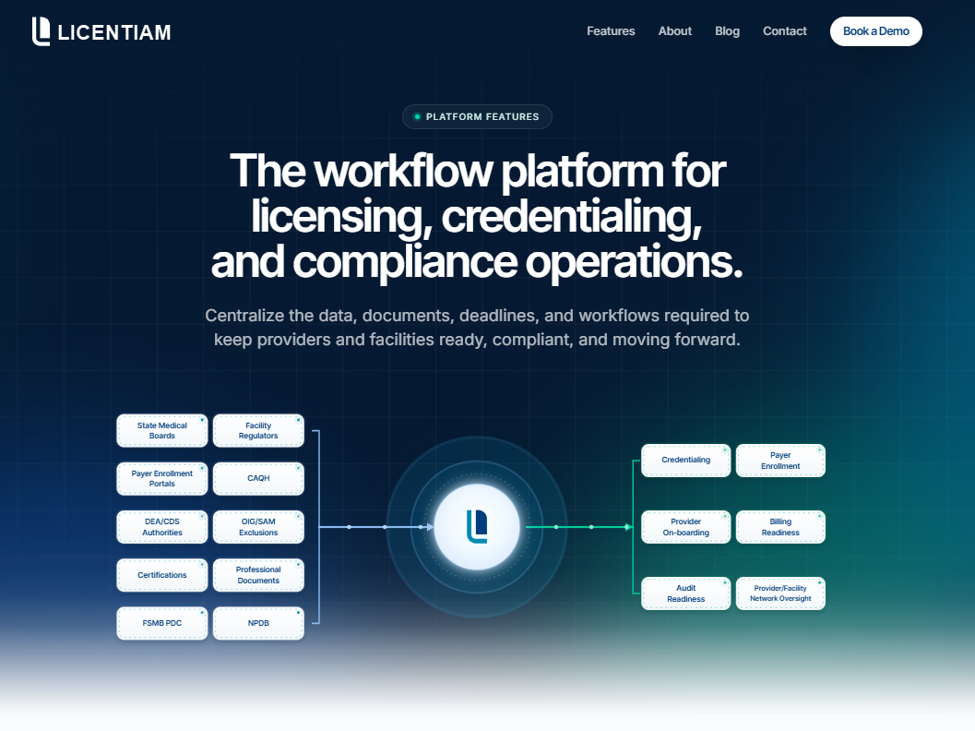
Licentiam combines an AI-powered CRM with tech-enabled services to simplify provider licensing, credentialing, and payer enrollment across all 50 states and U.S. territories.
Teams use Licentiam to collect, organize, and manage all provider information in one place to eliminate the need for spreadsheets, email, and fragmented tools.
Licentiam also provides configurable and automated reminders that track license status, renewal timelines, and required documentation for different provider types (e.g., doctors of medicine, registered nurses, etc.).
Plus, Licentiam is developing and releasing AI-assisted automation capabilities in phases, designed to reduce manual steps and supervision in the future.
What makes Licentiam stand out from other professional licensing services is the fact that it stays with you throughout the entire process. Most services only focus on preparing your application, and then they move on to the next client.
Licentiam’s team and platform help you get different providers licensed, and it can help you keep them in good standing. This approach maintains ongoing compliance and prevents lapses in your ability to practice.
Request a demo to see how Licentiam streamlines licensing and credentialing processes!
FAQs About Provider Licensing
What are the three types of licensing?
In healthcare, licensing often falls into three groups. These include professional licenses for individuals, facility licenses for care sites, and payer-related licenses tied to billing. Each type supports the legal delivery of healthcare services and is reviewed by separate agencies or boards.
What is a licensed service provider?
A licensed service provider is a person who has received formal approval from a state board to deliver medical care. This approval confirms that the provider met education and training rules. Without a valid license, a provider cannot legally practice in that role.
What is an example of licensing?
One example of licensing is a state medical board granting a physician approval to practice medicine. The license outlines what services the provider may offer and may include limits based on specialty, setting, or past history.