
If you run a clinic, hospital, or healthcare group, you already know how stressful provider credentialing can be. Missing licenses, expired documents, and delayed approvals can harm patients, delay billing, and affect your company’s reputation.
That is why many healthcare organizations are moving away from spreadsheets and email threads. They turn to digital software to streamline credentialing, manage documents from a single location, and keep providers compliant across states.
This article discusses the best provider credentialing solutions and their core features. You’ll also learn why using credentialing software is important.
7 Best Healthcare Provider Credentialing Software Reviewed
Below are detailed reviews of the best provider credentialing platforms.
1. Licentiam
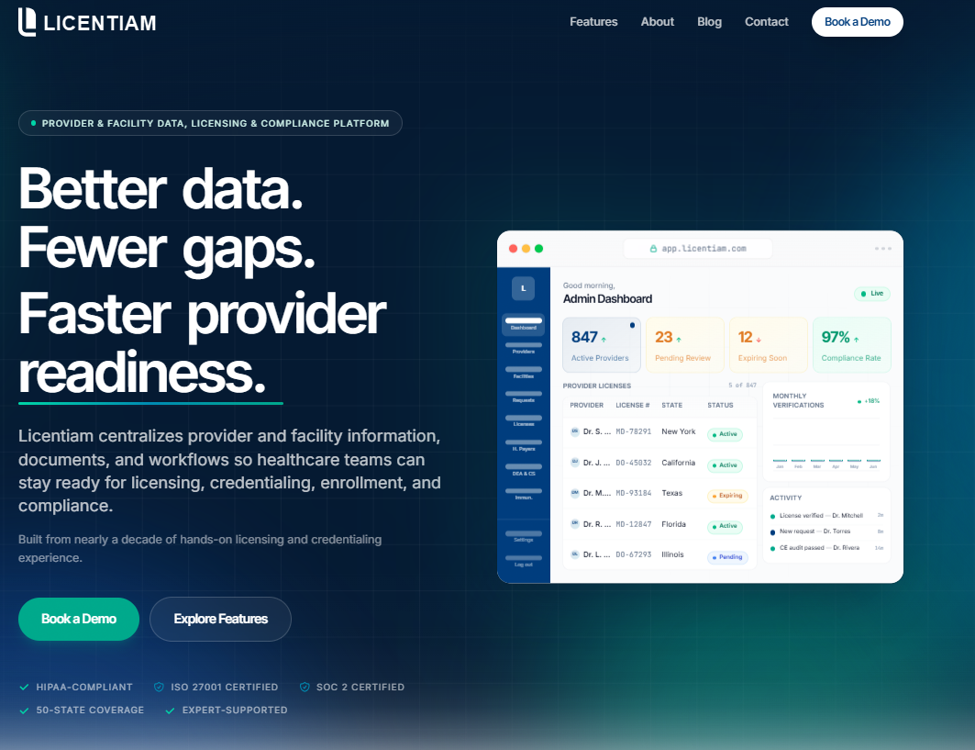
Licentiam is a full-service provider credentialing solution that transforms paper-heavy, manual processes into scalable processes.
It integrates a centralized CRM, a secure repository, and technology-enabled services into one platform. This streamlines provider credentialing and enrollment workflows in private and government insurance payers across all 50 states and U.S. territories.
Teams use Licentiam to consolidate provider data, standardize tasks, monitor licensing status, and maintain clear oversight for audits and renewals.
Licentiam also includes configurable reminders and compliance monitoring workflows to proactively address issues and improve audit readiness.
Plus, Licentiam is rolling out AI-assisted automation in phases to cut down manual tasks, enhance consistency, and accelerate time to revenue.
In fact, this approach helped clients reclaim 3,500+ hours of administrative time—time that can be redirected to patient care and revenue generation.
Request a demo today to learn how Licentiam transforms provider credentialing workflows!
Key Features
- License tracking and renewal reminders: Monitor state license status, renewal schedules, and required documentation for all provider types, including MDs, DOs, NPs, and RNs.
- Provider and facility network management: Oversee all providers and facilities on a single platform to support compliance oversight.
- Secure document repository: Store all provider information in one central system for faster access during audits and renewals.
- Primary source verifications: Licentiam’s data integrations with regulatory and insurance databases streamline PSV workflows. It supports immediate credential verifications, audit-ready records, and automated profile updates.
- Provider data management CRM: Automate provider and facility data collection workflows. You maintain a single provider record for licenses, credentials, and contacts.
- OIG exclusion and background checks: Proactively screen providers against OIG exclusion lists and confirm qualifications to support regulatory compliance across NPDB and state licensing authorities.
- CEU management: A built-in continuing education unit (CEU) tracker automatically checks State Board requirements, so you can track CEUs tied to license renewal. You can also connect users directly to preferred CME partners.
- Compliance alerts: Receive notifications when licenses, credentials, or compliance tasks need action.
- Audit-ready reports: Reporting tools support compliance and enhance leadership visibility.
- Client onboarding: Centralize provider data and begin tracking tasks, status, and documentation.
Book a demo today to see Licentiam’s core features in action!
2. symplr
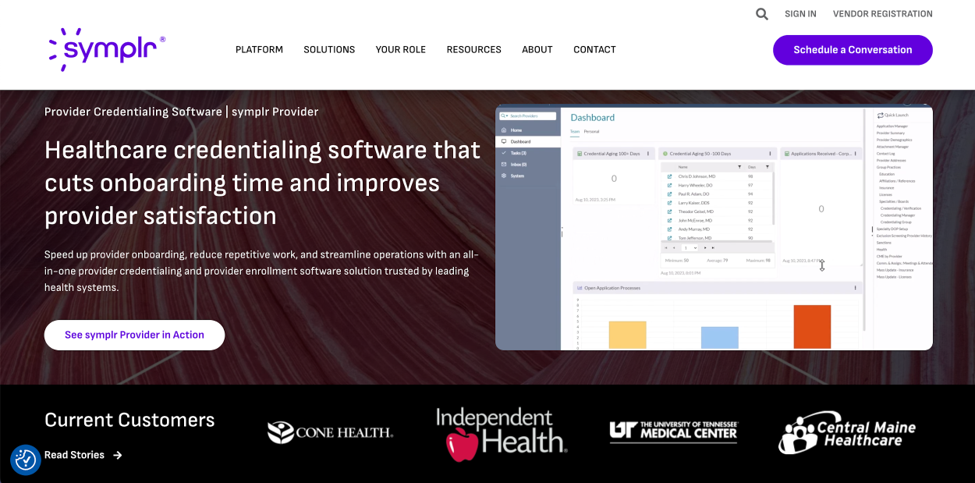
Symplr is a credentialing software designed to shorten credentialing timelines through automation. It automatically handles data collection and verifications, which can speed up provider onboarding.
It also offers an end-to-end solution that allows organizations to manage credentialing, privileging, provider enrollment, and provider performance in one connected system. This reduces the need for spreadsheets and manual handoffs.
The platform connects to primary sources and regulatory databases, making it easier to complete the provider verification process.
Plus, it taps an extensive library of more than 9,600 delineated privileges with embedded ICD/CPT codes. That means faster privilege list development and deeper data analytics.
Key Features
- Provider lifecycle management: Track healthcare professionals, from application and ongoing credentialing to performance monitoring.
- Automated workflows: Execute end-to-end credentialing steps in minutes.
- Extensive privileging library: Access over 9,600 delineated privileges to speed up the privileging process.
- Provider enrollment: Manage the enrollment process and generate rosters that include added, deleted, and changed data.
- Custom reports: Generate ad hoc queries and prepare for audits without requiring SQL commands or programming experience.
3. Medallion
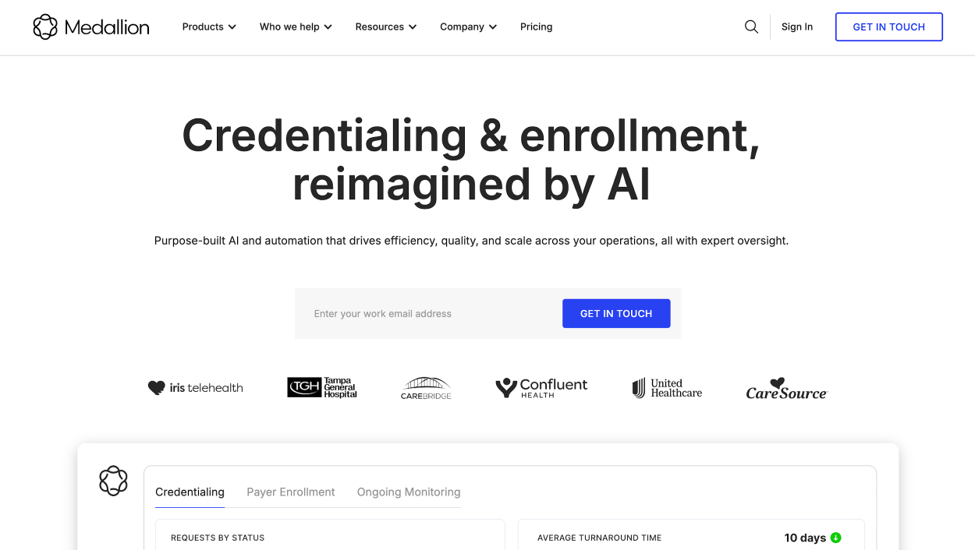
Medallion offers a unified platform that automates provider credentialing, payer enrollment, monitoring, and licensing.
The system uses AI to manage complex workflows and eliminate administrative burdens. It reviews provider data, checks for missing or outdated items, and flags issues that could delay payment. This reduces tedious tasks for credentialing teams and helps them catch problems earlier.
Tasks are also automatically sequenced depending on payer, state, provider type, and historical outcomes. That means more accurate credentialing with fewer human errors.
Need to prove outcomes? Medallion also translates operational data into actionable insights, which are accessible from an intuitive dashboard. This helps optimize performance, identify blockers, and show ROI to leadership.
Key Features
- Automated PSVs: Confirm provider credentials directly with primary sources, such as state medical boards or the Drug Enforcement Administration (DEA) database.
- Payer enrollment: Automate initial application submissions, eliminate manual tasks, and track enrollment status in real time.
- Dynamic workflows: Tasks automatically adapt based on provider type, payer, state laws, and historical outcomes.
- Actionable insights: Highlight immediate outcomes that improve decision-making.
- Built-in compliance tracking: Monitor provider credentials against industry standards (NCQA, Joint Commission, and CMS) and identify gaps before they cause problems.
4. Modio Health OneView
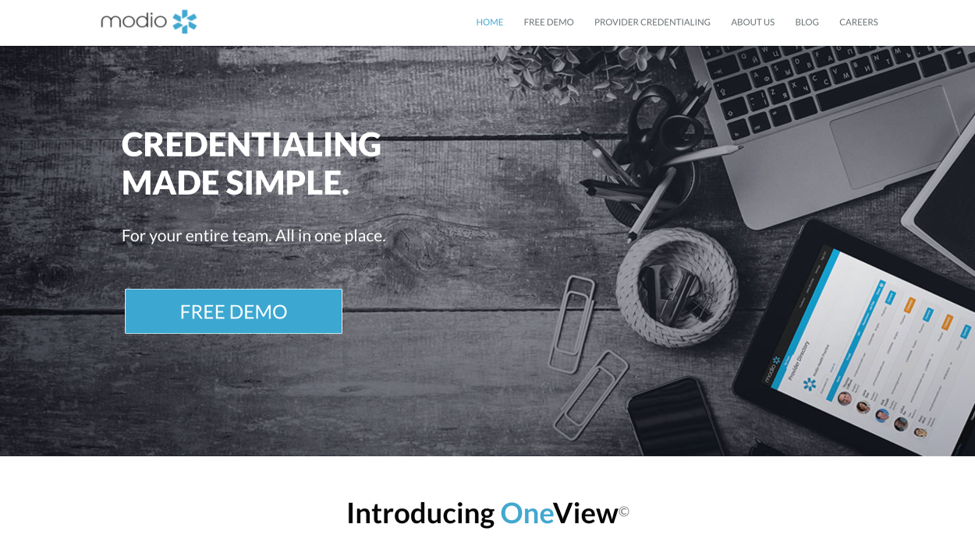
Modio Health OneView makes the credentialing process easier by centralizing provider data. It offers a cloud-based repository that securely stores all credentials and licenses. This eliminates the need to sort through files across different systems or send emails to busy doctors.
It’s also quick to set up credential providers and manage teams within minutes. The platform instantly matches healthcare professionals to job opportunities based on their qualifications and preferences. Then, it automatically gathers most data to reduce manual work.
Modio Health supports ongoing monitoring. It tracks payor enrollment, license renewals, re-credentialing processes, and alerts staff on changes. This helps teams stay aware of provider status across states and roles.
The software can even help manage a provider’s CME (Continuing Medical Education) credits. It partners with reputable medical schools, so providers can easily fulfill the required hours.
Key Features
- Centralized provider data: Store documents in a secure cloud-based system and access them anywhere, anytime.
- Automated data collection: Let the software gather all required data from providers, so you can focus on verifying information.
- Workflow tracking: View credentialing progress and outstanding tasks for each healthcare provider.
- CME management: Track continuing education credits linked to license needs and allow providers to fulfill hours with preferred CME partners.
- Compliance alerts: Receive up-to-date information on expiring licenses or certificates.
5. Mocingbird
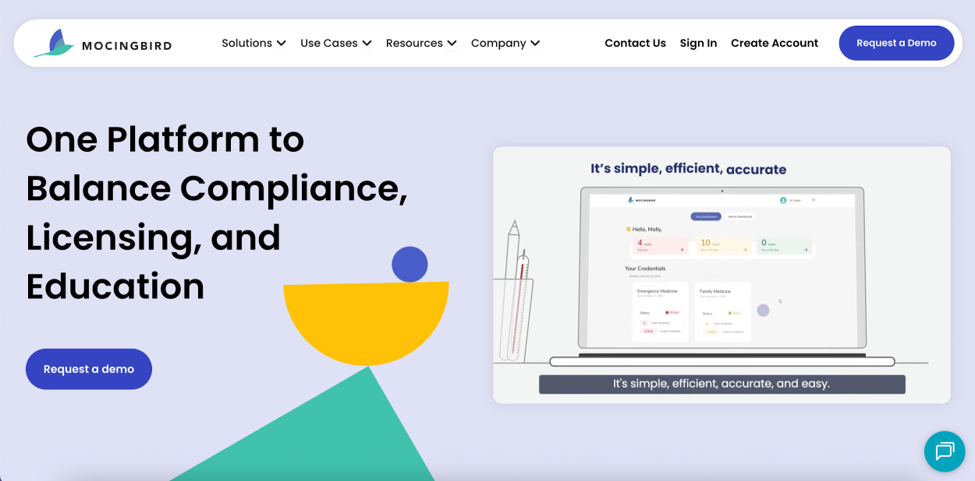
Mocingbird is a credentialing software designed to help healthcare organizations streamline license renewals and continuing education requirements.
It provides a centralized dashboard that shows credential status, applications, due dates, and renewal timelines. Teams receive real-time updates and reminders when action is required. This helps reduce missed renewals and last-minute issues that can stop providers from working.
Mocingbird also tracks continuing education requirements alongside licenses and certifications. This allows internal staff to see both credential and education status in one place. Providers can upload documents directly, which cuts down on email requests and follow-ups.
Plus, the platform has a curated learning center with various CME options from accredited institutions. Each course matches clinicians’ specialties and state requirements. This way, professionals stay updated with the latest knowledge in the healthcare field.
Key Features
- Credential and administrator dashboards: Stay on top of licensing data, CME requirements, and compliance statuses from one unified platform.
- Automated requirement tracking: Mocingbird’s software uses advanced automation to monitor due dates, reminders, and state-specific requirements.
- Application status monitoring: Track real-time progress for licensing and certification applications to reduce delays.
- File cabinet: This cloud-based repository offers centralized visibility into all ongoing licensure information and related documentation.
- Integrated learning center: Provide curated CME options from accredited providers, tailored to clinicians’ specialties and state requirements.
6. CredentialStream
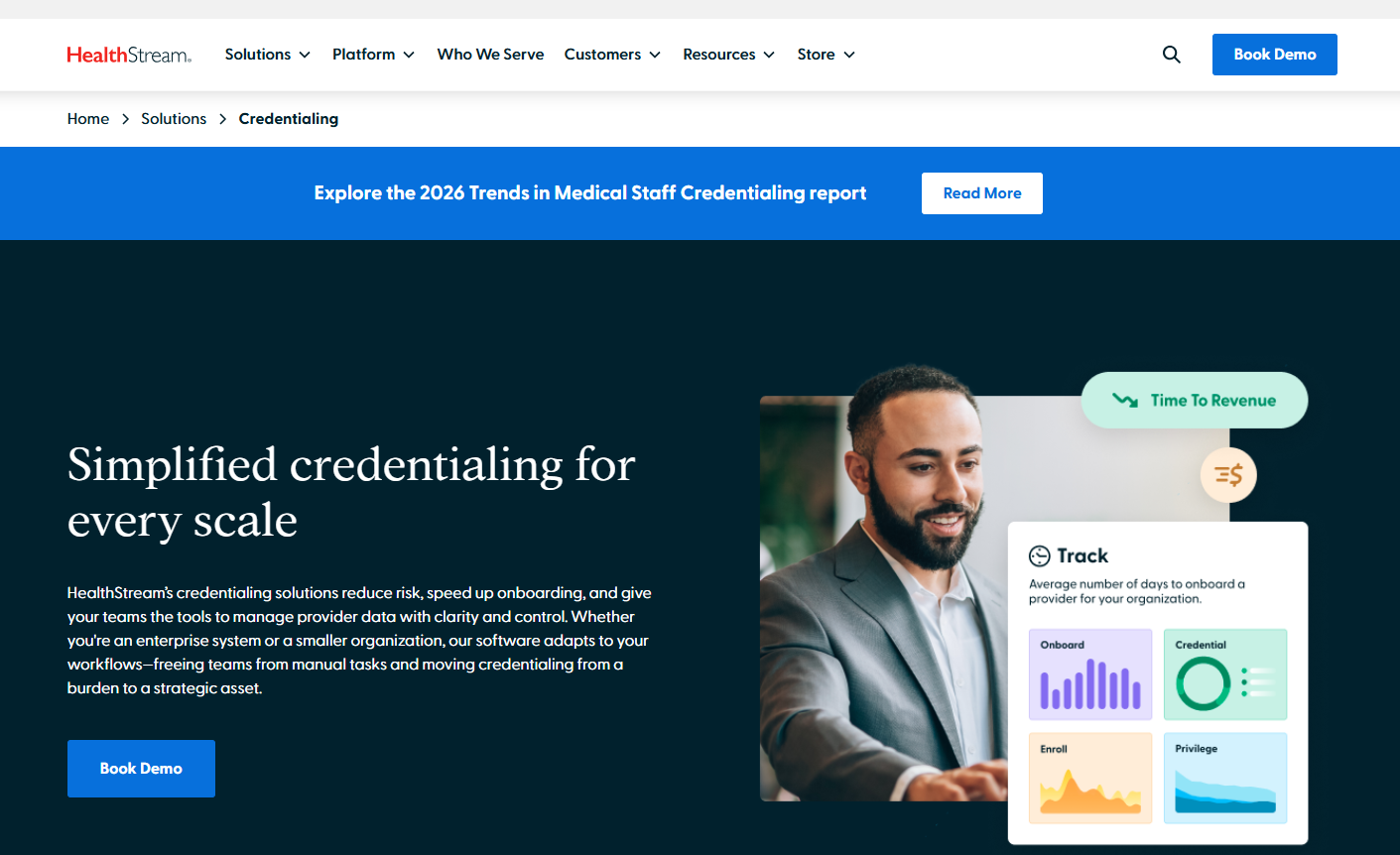
CredentialStream combines credentialing, enrollment, and privileging in one intelligent and secure platform. This reduces the need for back-and-forth emails and ensures a faster provider onboarding.
The software maintains a single source of truth across your healthcare organization. It removes redundancy and data silos.
It also includes a self-service portal that allows providers to upload their documents directly for your team’s review.
Meanwhile, a collaboration hub helps department chairs and medical staff services make shared decisions and plan for next steps without the risk of miscommunication.
CredentialStream also provides access to a library of performance metrics and appointment packet templates. These help you identify performance improvement opportunities.
Key Features
- Centralized data management: Store provider credentials, privileges, and enrollment data in one system.
- Paperless applications: Collect applications and documents through a self-service portal.
- Collaboration hub: Improve communication between providers, department chairs, and medical staff professionals (MSPs).
- Operational benchmarking: Compare provider timelines, workload, and referral trends against best practices in the healthcare industry.
- Seamless integrations: CredentialStream works with other HealthStream products to provide a more unified way to manage credentialing processes.
7. Verisys
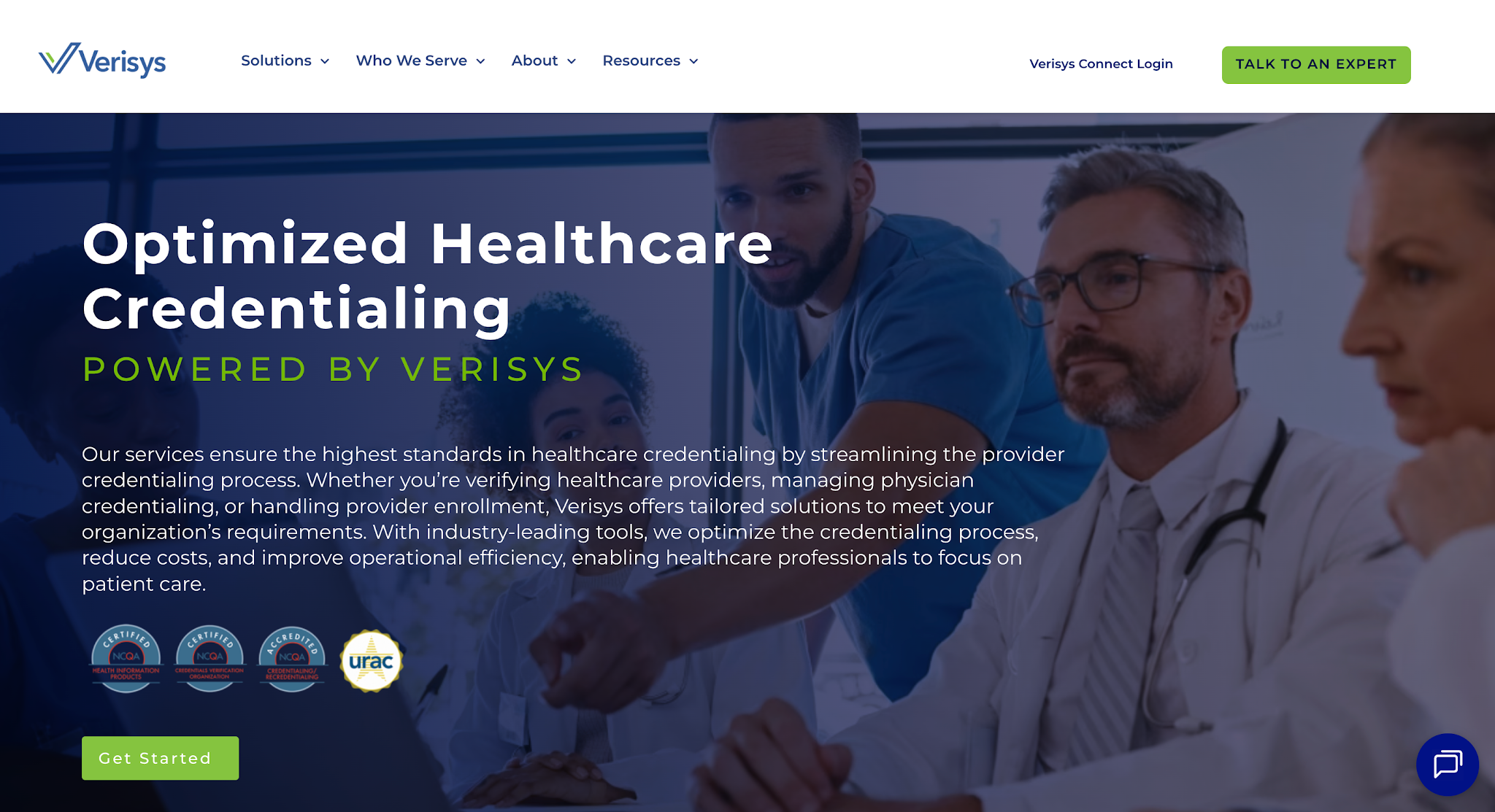
Verisys is a medical credentialing software that offers tailored solutions and industry-leading tools to meet your organization’s requirements.
It improves operational efficiency through verified data, accurate verification processes, and seamless integration with health plans. This helps your internal team reduce turnaround times.
The platform connects directly to trusted primary data sources for faster, more accurate credentialing. It also continuously checks provider information and ensures it aligns with industry standards.
Speaking of standards, Verisys can handle requirements set by the NCQA, URAC, the Joint Commission, and other regulatory bodies. It supports credentialing for all taxonomies and all provider types.
If you prefer to outsource some or all aspects of provider credentialing, Verisys can also act as a CVO (Credentials Verification Organization). It manages the most difficult tasks for your organization, so you can save time and focus on patient care.
Key Features
- Primary source verifications: Confirm credentials directly with official issuing sources and automatically attach data to a provider’s profile.
- Provider data management: Store and access provider information from a central database.
- Real-time monitoring: Track all status changes and data to ensure it meets compliance standards.
- Comprehensive support: Support credentialing for all taxonomies and all provider types, such as MDs, RNs, and allied health professionals.
- Credentialing services: Outsource verification and credentialing tasks to Verisys CVO.
Why Should You Use Provider Credentialing Software?
Provider credentialing software helps healthcare organizations reduce risk, save time, and keep providers ready to work. Below are the main reasons why these platforms matter:
Eliminate Paperwork and Spreadsheets
Managing provider credentials by hand creates a tedious process that drains staff time and increases mistakes. Paper files, shared drives, and spreadsheets make it hard to track licenses, documents, and deadlines.
Credentialing software replaces these tools with one system that stores everything in one place. Your team spends less time searching for files and more time handling approvals and reviews. This reduces duplicate work, missed items, and confusion across departments.
Reduce Costly Delays and Administrative Burden
Delays can stop healthcare providers from seeing patients and slow down billing.
Fortunately, credentialing software shows real-time task status. This gives your team knowledge of what is pending and who needs to act.
Software also sends automated reminders, which reduce follow-ups and long email chains. That leads to fewer manual tasks and faster provider onboarding.
Centralize Credentialing Data
Provider credentialing platforms reduce errors and inconsistencies by maintaining a single source of truth.
Everyone works from the same data, which reduces confusion and repeated requests.
Centralized records also make it easier to support multi-site clinics and hospitals. Credentialing staff can review provider status quickly without switching between multiple systems or folders.
Meet Regulatory Compliance
Credentialing software improves compliance by tracking expirations, verifications, and required checks in one place. It also notifies internal staff before licenses or credentials lapse to maintain regulatory compliance.
Most platforms also generate audit-ready reports. These lower the risks tied to missing records and help your organization comply with state boards, payers, and internal policies.
Improve Patient Safety
Provider credentialing software helps protect patients by keeping qualifications current and visible. When you track licenses, certifications, and required checks in one system, you reduce the risk of expired or missing credentials.
Internal teams can confirm provider readiness before care is delivered, rather than reacting after issues appear.
Software also supports better patient outcomes by ensuring providers have updated training, education, and knowledge. It conducts ongoing monitoring and provides CME management features.
Licentiam Makes Provider Credentialing Easy
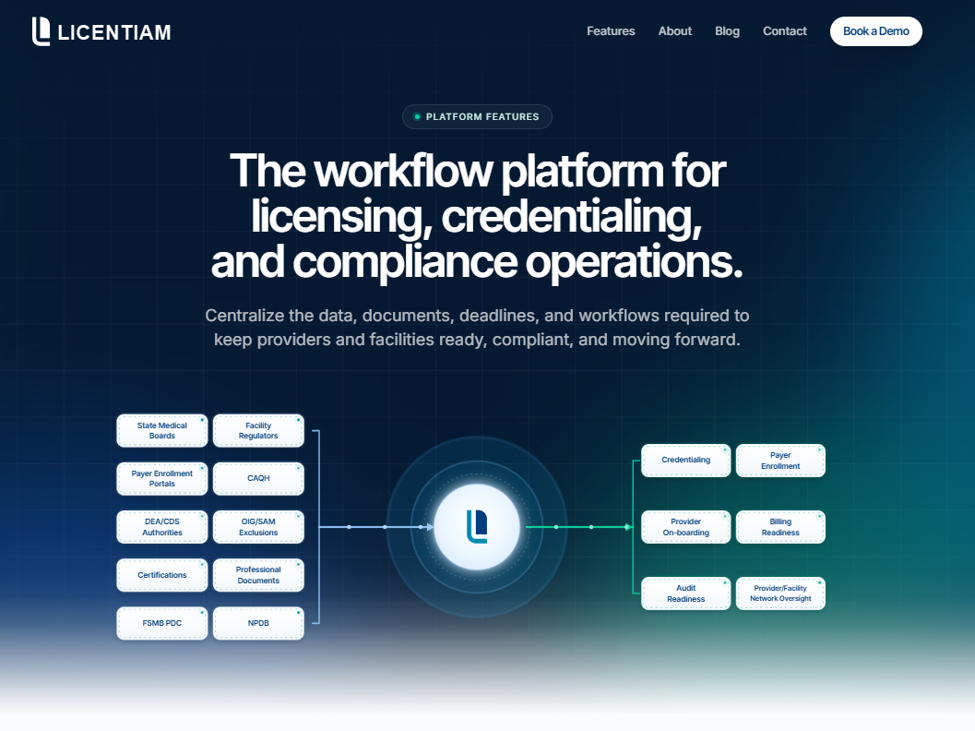
Licentiam is a full-service credentialing solution that streamlines provider licensing, credentialing, and payer enrollment workflows across all 50 U.S. states and territories.
It combines a centralized Vault CRM with tech-enabled services that provide access to a secure document repository, OIG monitoring, license tracking tools, CEU management, and audit-ready reports.
Licentiam is also launching AI-assisted automation capabilities in phases to reduce risk, improve consistency, and accelerate time to revenue.
This approach helps teams avoid lost revenue (more than $200K each month per physician when credentialing is delayed) and save over 20 admin hours per provider in manual work.
With Licentiam, you can focus on care provision and revenue generation rather than administrative tasks.
Request a demo of Licentiam today to get providers licensed and credentialed faster!
FAQs About Provider Credentialing Software
What is the best credentialing software?
The best provider credentialing software depends on your organization’s size, structure, and workload. Licentiam stands out for its automated workflows, provider network CRM, centralized database, built-in OIG exclusion or background checks, and robust reporting.
How much does credentialing software cost?
Credentialing software pricing largely varies based on features, provider count, and service levels. Some platforms offer a monthly subscription, while others charge per provider.
How do you choose the right provider credentialing software?
To select the right credentialing platform, consider a user-friendly interface, compliance features, data security, automated tools, and integration capabilities. You should also request demos and read peer reviews to learn the pros and cons of each software tool.