
Physicians have an integral role in patient care. They diagnose illness, guide treatment, and make decisions that affect patient safety every day.
Due to this responsibility, healthcare organizations must confirm that every physician has the right training, licenses, and background before allowing them to see patients.
That is where physician credentialing comes in. It checks a physician’s qualifications against primary sources to meet payer rules, follow accreditation standards, and protect patients.
This guide breaks down the entire physician credentialing process to help you manage it confidently. But first, let’s define credentialing.
What Is Physician Credentialing?
Physician credentialing is the process of verifying a physician’s identity, licenses, work history, education, and training before granting privileges.
Physician credentialing is not the same as credentialing for all other healthcare providers. Provider credentialing covers a wider group of healthcare professionals, such as nurse practitioners, physician assistants, allied health professionals, and other medical staff members.
In contrast, physician credentialing only applies to doctors, including MDs and DOs, who provide services within a healthcare facility.
The purpose of credentialing is to confirm that doctors have the necessary qualifications to treat patients under your organization’s name. It helps you reduce risk, ensure patient safety, and meet payer and accreditation rules.
Without proper credentialing, your healthcare facility may face delays (e.g., patient care or reimbursements), denied claims, lost revenue, or even compliance violations, such as billing for services rendered before a doctor’s effective date.
Step-by-Step Physician Credentialing Process
Below are the seven key steps in the physician credentialing process.
1. Collect Physician Information and Required Documents
The credentialing process begins when your organization collects detailed information from the physician. This includes their personal identification, state licensure, board certifications, employment records, and malpractice history.
You also gather proof of proper education, which can come from medical schools, residency programs, and fellowship programs.
Make sure the physician submits complete information during this initial application process. Missing or forgotten details can lead to delays.
2. Conduct Primary Source Verifications
After receiving the physician’s application, you should verify all the information through the primary source verification process.
Validate documents directly with original issuing sources, not third parties or copies supplied by the physician.
You can contact medical schools, state licensing boards, and certifying organizations to ensure the accuracy of information submitted.
If the primary source finds data mismatches or expired records, it’s important to resolve them before moving to the next step.
3. Review Work History and Professional References
Next, you review the physician’s work history and professional references. This step focuses on past roles, clinical experience, and previous hospital privileges received.
Confirm employment dates and job titles with past employers.
If the physician owned or worked in a private practice, verify their professional background through business records, payer contracts, tax documents, or attestations from partners or supervising physicians.
When you find gaps in work history, ask the physician for a written explanation and supporting documents when available.
You should also contact peer references shared by the physician. Doing so helps confirm competence, ethics, and teamwork skills, which are crucial in healthcare delivery.
4. Perform Background Checks and Sanctions Monitoring
It’s important to conduct background checks to identify legal or compliance risks.
Review national and state databases for sanctions, exclusions, or disciplinary actions. This includes checks tied to fraud, malpractice, or illegal distribution of controlled substances.
Sanctions monitoring also confirms the physician is not barred from working with private insurers or government programs, such as those from the Centers for Medicare and Medicaid Services (CMS).
If an issue appears, you must carefully review the details and decide whether it affects physician eligibility.
5. Submit Documents for Committee Review
After completing primary source verifications and background checks, you send the credentialing file for committee review.
This committee is usually made up of physicians, hospital directors, and administrative staff who review provider qualifications.
They may ask additional questions or request more information. Their role is to confirm that the physician meets internal standards set by your healthcare organization.
6. Approve Physicians and Initiate Provider Enrollment
After careful review, the committee makes a final decision to approve or deny the physician.
If approved, the committee grants privileges based on roles and medical specialties. This approval allows the physician to practice medicine within your healthcare organization under defined limits.
The physician also goes through payer enrollment. This step allows them to bill for services rendered under your organization’s name.
While credentialing approval allows the physician to begin seeing patients, payment for services can only begin after finishing payer enrollment.
7. Ensure Continuous Monitoring
The physician credentialing process continues after approval.
You need to ensure licenses, certifications, and enrollments stay current over time. Regularly track expiration dates and changes in status to keep files accurate.
When you always update records, you’ll find the recredentialing process easier to complete.
You can also face compliance audits with confidence, since documents are already organized and ready for review.
Key Documents Required for Physician Credentialing
Many hospitals and managed care organizations look for the following requirements when credentialing physicians:
- Completed and signed physician application
- Government-issued photo ID
- Curriculum vitae
- Medical school diploma and transcript of records
- Residency and fellowship certificates
- Active license from state medical boards
- Board certifications
- Drug Enforcement Agency (DEA) registration
- Malpractice insurance coverage
- Malpractice claims
- Recommendation letters or peer references
- Taxpayer Identification Number (TIN) and Medicare enrollment forms
Challenges When Credentialing Physicians and Other Healthcare Providers
Below are the challenges to expect when credentialing doctors and other medical staff.
- Outdated or missing information: When physicians submit expired licenses or incomplete records, medical credentialing teams need to follow up repeatedly before files can move forward.
- Paper-based workflows: Manual forms and paper files increase errors and lost documents. In most hospitals, paper workflows also limit visibility into application status and cause longer review times.
- Slow responses from governing bodies: Verification processes depend on outside groups like medical schools and state licensing boards. However, they may reply after several weeks or longer during busy periods, which delays physician start dates.
- Communication gaps between teams: Credentialing, HR, and billing departments often store provider files in different places. This poor coordination leads to duplicate work, missed updates, and unclear ownership of tasks.
- Evolving regulatory standards: Credentialing rules change over time. Keeping policies aligned with new minimum requirements takes constant review and updates to internal processes.
Tips to Improve Physician Credentialing
Small process changes can reduce delays, errors, and repeated work during physician credentialing. Consider implementing the following tips:
Standardize Workflows
Create a clear credentialing workflow that applies across your healthcare organization. Define several key steps and assign ownership for each stage.
For example, set fixed steps for primary source verifications, such as when teams send requests, handle follow-ups, and log responses.
Use the same forms, checklists, and review rules for every physician. Doing so keeps files consistent and reduces missed details.
Standard workflows also make training easier, helping staff know exactly what to do at each stage of the physician credentialing process.
Centralize Provider Credentialing Data
Store all credentialing resources in one shared system instead of separate folders or emails.
Centralized data gives your team one source of truth. This makes it easier to track status, expirations, and missing items.
Central access also supports faster reviews and helps teams respond quickly to audits, payer requests, or compliance questions.
Consider a Credentials Verification Organization (CVO)
A CVO can handle verification tasks on behalf of healthcare organizations or health plans. This reduces manual work and follow-ups for your internal credentialing team.
Before choosing a CVO, review their scope, turnaround times, and data access rules. Having clear expectations avoids delays or gaps in responsibility.
Invest in Credentialing Software
Credentialing software replaces manual tracking with standardized and scalable processes.
It lets you manage physician documents, reminders, and review stages in one place. This helps you stay organized for audits and renewals.
The software also improves license and credential status visibility across providers. You can quickly identify and address issues before they lead to compliance violations, like treating patients with expired licenses.
Licentiam Makes Physician Credentialing Easy
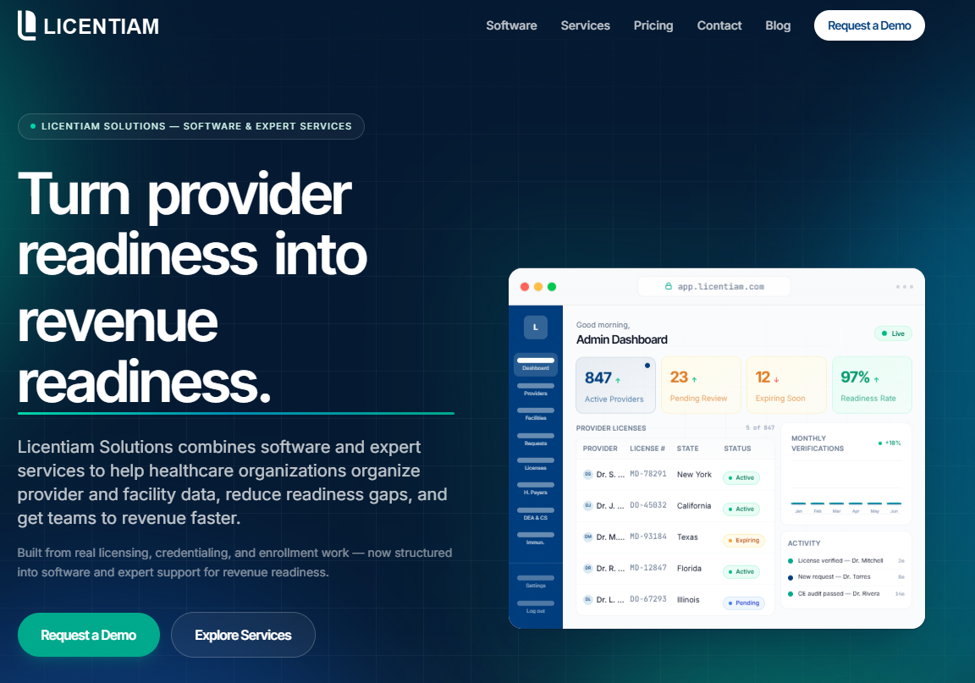
Licentiam offers a full-service credentialing solution designed to streamline physician credentialing, licensing, and payer enrollment workflows across all 50 states and U.S. territories.
Licentiam is built on an existing, production-tested compliance CRM platform that centralizes documentation, standardizes workflows, enhances visibility, and supports ongoing compliance operations.
AI-assisted automation features are also being developed and launched in stages—aiming to cut down manual work, improve consistency, and accelerate time to revenue.
In fact, clients use Licentiam to track and monitor credentials for all their healthcare providers, not just physicians. Licentiam’s team and platform help validate provider qualifications to comply with state boards and insurance payer requirements.
Schedule a demo today to learn how Licentiam reduces administrative burden for your credentialing team.
FAQs About Physician Credentialing
What is physician credentialing?
Physician credentialing is the process used to confirm a doctor’s education, licenses, training, and work history. It allows a healthcare organization to decide whether a physician can receive clinical privileges and provide patient care under its name.
How often do physicians need to be credentialed?
Physicians are usually credentialed when they first join a medical practice or organization. They also undergo the recredentialing process every two to three years.
What does a physician credentialing specialist do?
A physician credentialing specialist manages credentialing tasks, such as collecting documents, requesting verifications, and tracking approvals. This individual presents files for committee review, but they do not vote on approvals or privileging.