
Medical staff credentialing affects how your healthcare organization brings providers into patient care. Before a doctor, nurse, or specialist can treat patients, you should confirm their education, license, work history, and background.
This review helps you determine whether they meet the minimum requirements and standards before granting specific practice privileges.
In this article, you will learn the definition, importance, and step-by-step workflows of medical staff credentialing. You’ll also understand the challenges and the best practices you can implement to manage credentialing effectively.
What Is Medical Staff Credentialing?
Medical staff credentialing is the formal review of a provider’s qualifications before allowing them to deliver care within a healthcare facility.
It confirms that the staff meet the credentialing standards set by a hospital or a clinic to practice safely and within their role.
This process applies to many types of healthcare professionals. That includes primary care physicians, physician assistants, nurse practitioners, and other allied health practitioners, such as therapists and paramedics.
Medical staff credentialing usually focuses on verifying education, training, licensure, experience, and current competence. The goal is to confirm that each healthcare provider has the background required to perform the services they request.
Why Medical Staff Credentialing Matters
Below are the reasons why medical staff credentialing is important.
Protect Patient Safety
Medical staff credentialing helps your organization reduce errors by confirming that healthcare providers meet clear qualification standards.
When you allow only approved clinicians to treat patients, you lower the chance of care being delivered by someone without the right background. This matters in every setting, from hospitals to outpatient clinics.
Credentialing confirms that licenses are valid and training is complete before patient contact begins. It also supports ongoing review as providers renew licenses or change roles.
By setting firm approval rules, your healthcare organization places patient safety first and limits avoidable harm tied to staffing gaps or unchecked credentials.
Ensure Quality Care
Quality care depends on knowing that providers are trained for the services they deliver. Medical staff credentialing creates a clear standard for healthcare delivery by confirming that each provider meets defined clinical requirements.
When you review and approve provider credentials, leadership can trust that care teams are built on verified skills and experience.
Credentialing also helps align provider roles with training history. This alignment supports consistent care across different locations and reduces variation tied to staffing decisions.
Meet Regulatory Compliance
Healthcare organizations should follow many regulations tied to medical staffing and oversight.
Fortunately, credentialing supports compliance with local and federal laws that require provider verification before care begins.
Regulators and accrediting bodies expect proof that licenses, education, and sanctions have been reviewed and approved. Your organization may face audits, penalties, or service restrictions if you fail to present credentialing and privileging records.
Having clear credentialing workflows and complete documentation helps you comply with the standards set by the Joint Commission (TJC).
Secure Financial Reimbursements
Payers often require proof that healthcare providers are properly approved before they cover services.
Without credentialing, your claims may be denied or delayed. This affects revenue flow and staff workload.
Proper credentialing helps you secure reimbursement by showing that healthcare providers meet the standards set by the governing body of your organization. It also protects cash flow and accelerates time to revenue.
Enhance Reputation in the Healthcare Industry
A strong credentialing program can build trust with patients, partners, and oversight groups. It lowers potential risks tied to provider quality or compliance gaps.
Medical staff credentialing also plays a role in risk management by showing that leadership reviews and approves who may practice within a facility. When issues arise, clear credentialing records support internal review and response.
Over time, this consistency helps your organization maintain credibility with staff, payers, and the public. A clear approval process shows that you take healthcare provider oversight seriously.

Step-by-Step Medical Staff Credentialing Process
Medical staff credentialing involves the following steps:
Step 1: Collect Medical Provider Information
The first step in medical staff credentialing focuses on gathering all the required information from the healthcare provider.
You typically collect education history, including medical school, residency, and fellowship records. You should also require licensure details from each state where the provider has practiced.
Meanwhile, work history, hospital affiliations, and peer references help confirm past roles and clinical competency.
Here are the other details to collect and verify:
- Government-issued identification
- Board certificates
- National Practitioner Data Bank (NPDB) query
- Background information (criminal history, identity issues, or other findings that may affect provider privileging)
- Malpractice coverage details
- Claims history
After data collection, review the provider’s application to confirm that all required fields are completed and signed.
If details are missing or additional resources are required, communicate this with the provider before moving on to the next steps.
Step 2: Conduct Primary Source Verification
Primary source verification (PSV) confirms that the information submitted by the provider is accurate and valid.
During this step, your organization verifies credentials directly with the original issuing sources, not third parties or copies supplied by the provider.
For example, in order to confirm medical education, you need to contact schools and training programs.
When it comes to licenses, you can validate their current status, issue dates, and any restrictions through state licensing boards.
Primary source verification supports alignment with accreditation standards set by oversight groups. It creates a clear record showing that you reviewed staff credentials at the source level.
For healthcare organizations, this step confirms that provider information is reliable before approval decisions move forward.
Step 3: Perform Sanction Screenings and Background Checks
After conducting PSV, you can screen healthcare providers against federal and state databases.
Common checks include the System for Award Management (SAM) and the Office of Inspector General (OIG) exclusion list, known as the List of Excluded Individuals/Entities (LEIE). These databases show whether a provider is barred from federal healthcare programs.
You can also conduct criminal background checks, depending on the role or specific state laws. Doing so reduces exposure to billing issues, legal action, and other care concerns.
Step 4: Submit Files for Credentialing Committee Review
Once initial verification and screenings are complete, the credentialing file moves to committee review.
This step involves presenting a complete record of the provider’s qualifications for formal evaluation. The file includes provider education, licenses, work history, verification results, and screening outcomes.
The credentialing committee reviews the file to confirm that all requirements have been met. They are responsible for evaluating whether the provider meets the healthcare organization’s standards and requested clinical role.
The committee may also request more details or clarification before moving forward. Their review helps maintain clear oversight before granting any clinical privileges.
Step 5: Approve Privileges and Scope of Practice
This step defines what clinical services a medical staff member is allowed to perform within your healthcare organization.
Committees usually review requested privileges against credentialing records before approval. They grant privileges based on verified training, education, work experience, and role.
The scope of practice limits healthcare providers to tasks they are qualified to perform.
For example, a doctor of medicine may receive privileges to admit patients, perform inpatient procedures, and lead treatment plans. Meanwhile, an advanced nurse practitioner may be approved to assess patients, prescribe medication, and manage care within defined limits.
Clear privilege definitions help prevent medical staff from performing services outside approved boundaries.
Step 6: Initiate Ongoing Monitoring and Re-credentialing
Medical staff credentialing does not end after initial approval.
You need to continuously check licenses, certifications, and sanctions on a regular basis. Review any changes, such as license actions or new restrictions, as they occur.
Then, re-credential medical staff every two to three years.
During this evaluation, your credentialing team reassesses education, work history, malpractice activity, and clinical performance. Require providers to submit updated information for review and approval.
This step matters because provider status can change over time. Continuous review helps your organization keep accurate records, maintain approved practice limits, and meet ongoing compliance.
Common Medical Staff Credentialing Challenges
Many healthcare organizations face recurring issues that slow down credentialing and increase compliance risk.
- Manual and paper-based workflows: Paper forms create delays and errors. Credentialing teams spend extra time searching files, rechecking data, and correcting mistakes. This approach makes it hard to keep records current and respond quickly to reviews or audits.
- Data silos: Credentialing data often sits in separate systems across departments. HR, medical staff services, and billing teams may not share the same records. That causes gaps, duplicate work, and confusion when updates are needed.
- Incomplete requirements: Providers may submit missing or outdated documents. Incomplete files often slow down committee decisions and delay provider start dates.
- Delays: Verification responses from original issuing sources may take weeks. Internal backlogs also add time. These delays affect onboarding timelines and strain staffing plans, especially in high-demand departments.
- Lack of real-time data: Teams often lack real-time updates on license status or sanctions. Without timely alerts, changes may go unnoticed and increase risk.
- Compliance difficulties: Rules and standards change often. Keeping policies, records, and reviews aligned with current requirements takes time and focus.
Best Practices for Medical Staff Credentialing
To address the challenges above, you can implement the following best practices for credentialing:
- Centralize provider credentialing data: Store all credentialing records in one secure system. Centralized data reduces duplicate work, limits confusion, and allows teams to access accurate provider information quickly. It also supports faster reviews and clearer communication across departments.
- Automate verification processes: Automation reduces manual tasks tied to license checks, sanction reviews, and expirations. It also minimizes the chances of errors and compliance violations, such as billing for services before a provider’s effective date.
- Train medical staff professionals: Ongoing staff training supports consistent reviews and accurate documentation. Credentialing teams must stay informed on rules, review standards, and internal policies. Regular training also helps staff quickly answer provider questions and reduce processing delays.
- Invest in the right credentialing software: Technology can streamline licensing, credentialing, and renewals by transforming paper-heavy, manual processes into scalable workflows. It helps credentialing teams manage high volumes of providers through automation.
Licentiam Helps Get Medical Staff Credentialed Faster
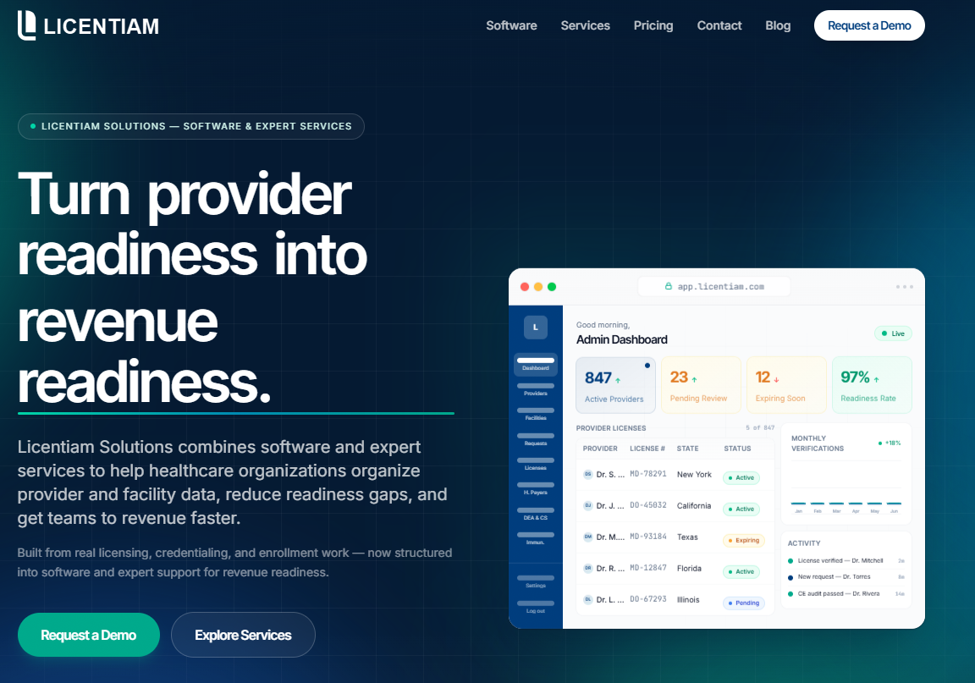
Licentiam helps healthcare organizations manage medical staff credentialing with less manual work and fewer delays.
The platform replaces spreadsheets and paperwork with a full-service solution for credentialing, licensing, and compliance tracking across all 50 states and U.S. territories.
Teams use Licentiam to track state license status, centralize provider data, monitor OIG exclusion lists (LEIE), manage CEUs, and report on compliance.
Licentiam is also releasing AI-powered automation capabilities in phases to reduce manual steps, ensure consistency, and speed time to revenue.
Clients have saved 3,500+ administrative hours as a result, having more time to focus on care delivery and revenue generation. They also reported an improvement in regulatory compliance and reputation in the healthcare industry.
Request a demo today to learn how Licentiam improves operational efficiency and compliance!
FAQs About Medical Staff Credentialing
What are the three types of credentialing?
The three main types are payer credentialing, hospital (health system) credentialing with privileging, and healthcare facility credentialing.
Payer credentialing allows providers to bill insurers. Hospital and system credentialing approves providers and their privileges. Facility or site credentialing confirms the inclusion of a specific care location, such as a clinic or hospital, in a payer’s network.
How to become a medical staff credentialing specialist?
Most specialists start with healthcare admin or medical staff services roles. Training often includes on-the-job learning, policy review, and credentialing software use. Some professionals pursue the Certified Provider Credentialing Specialist (CPCS) certification after gaining experience. Strong attention to detail and knowledge of provider records are key skills individuals should have.
Is the Certified Provider Credentialing Specialist (CPCS) certification worth it?
CPCS certification can be valuable for credentialing staff who want formal training and career growth. It shows knowledge of credentialing standards and review practices. Many healthcare organizations view CPCS certification as a sign of strong skills and long-term commitment to medical staff services.
What is the credentialing process in healthcare?
The credentialing process involves collecting provider information, verifying credentials, screening for sanctions, sending files to committee review, privilege approval, and conducting ongoing review.
Healthcare organizations follow this process to review qualifications and approve providers to deliver care within defined roles and limits.