
Medical credentialing is an important process for healthcare organizations that want to protect patient safety and receive payments from insurance companies.
If your healthcare providers are not properly credentialed, you may face claim denials, payment delays, or limits on patient care.
However, when done correctly, medical credentialing supports safe care, steady payments, and long-term trust.
This guide discusses everything you need to learn about medical credentialing. You’ll understand its definition, importance, and the step-by-step process.
What Is Medical Credentialing?
Medical credentialing is the formal review of a provider’s qualifications and background within the healthcare industry. It involves checking licenses, board certifications, work history, professional references, education, and training.
This critical process helps medical practices and healthcare organizations confirm that providers meet the necessary qualifications before granting clinical privileges.
Medical credentialing applies to many types of healthcare providers. This includes physicians, nurse practitioners, physician assistants, therapists, and other allied healthcare professionals.
The credentialing process is usually handled by trained medical staff services (MSS) within a healthcare facility or by a third-party entity, also known as a credentials verification organization (CVO).
The Importance of Medical Credentialing
Here’s why medical credentialing matters:
Meet Regulatory Compliance
Federal and state laws require healthcare organizations to verify provider licenses, training, and work history before granting privileges.
To ensure compliance, you should confirm that each provider holds an active license, has completed approved education, and has a valid work record.
Medical credentialing is a crucial step that helps you review provider information and qualifications before they treat patients.
It also creates a record that shows regulators your organization follows the necessary rules. This helps you avoid costly fines, lawsuits, or criminal charges.
Ensure Patient Safety
Patient safety starts with knowing who is allowed to treat patients.
Medical credentialing follows a clear vetting process that reviews a provider’s background, education, training, work history, and hospital affiliations.
This allows your organization to identify past issues, expired licenses, or restrictions that indicate risks to patient safety. Ongoing reviews also help catch new sanctions or changes in provider status.
Proper credentialing improves risk management by ensuring that only approved providers deliver healthcare services. This supports safer treatment decisions across clinics, hospitals, and managed care organizations.
Maintain High-Quality Patient Care
High-quality care depends on the qualifications and skills of the healthcare providers delivering treatment.
Medical credentialing follows a structured verification process to ensure each professional is qualified to provide services.
This review also helps you match providers to appropriate roles and limit privileges to approved scopes. It maintains consistent care standards and reduces risks linked to unqualified or unskilled providers.
Protect Cash Flow
Credentialing providers can directly impact revenue. Healthcare professionals must be approved as an in-network provider before your organization can receive reimbursement for services rendered.
If credentialing is delayed or incomplete, claims may be denied or placed on hold by the Centers for Medicare and Medicaid Services (CMS) or private insurers. This can slow payments and affect payroll.
Boost Credibility
Medical credentialing builds trust with patients, payers, and partners. It shows your organization follows clear approval rules before allowing providers to deliver care.
This strengthens your reputation, which can attract more patients and providers willing to work with your organization.
How Does the Medical Credentialing Process Work?
Below is a step-by-step guide to the medical credentialing process.
1. Initial Application Process
The credentialing process begins when a healthcare provider applies to your organization.
During this step, you gather personal details and required documents, such as licenses, certifications, education records, and work history.
Review each application carefully to ensure accurate and complete information. Errors or incomplete data can affect credentialing timelines, so it’s important to collect all critical information before the vetting process begins.
2. Primary Source Verification
Once you receive the applicant’s application, you need to check that the information provided is valid and up to date. This process is called primary source verification (PSV).
It involves contacting original issuing bodies rather than relying on the provider’s copies or secondary sources. Doing so ensures accuracy and credential authenticity.
For example, if you want to know if a provider has proper education, you can inquire with medical schools or residency programs.
To validate licenses, you can check with state licensing boards.
If you need to confirm work history and hospital privileges, reach out to the healthcare facilities listed on the provider’s application.
It may be challenging to verify the work experience of those with private practices, as they operate independently. However, you can always ask for their business permit, National Provider Identifier (NPI) records, and Drug Enforcement Administration (DEA) registration number.
3. Sanctions Screening
Primary source verification alone is not enough to fully validate a provider’s background. While PSV confirms licenses and education, it does not always reveal disciplinary actions or restrictions.
Sanctions screening and background checks can fill this gap.
These processes review federal and state exclusion lists, disciplinary databases, and enforcement records. They help you identify providers who may be barred from certain government programs or have active restrictions.
4. Data Assessment
After primary source verification and sanctions screening, you should carefully assess other key documents. These include government-issued identification, peer references, attestations, and malpractice insurance coverage, among others.
If you find missing information, inconsistencies, or red flags (e.g., expired licenses or malpractice claims), follow up with the provider to resolve issues.
This step supports fair and consistent review standards for every applicant. It also prepares the provider’s file for formal review by a medical staff committee or another governing body.
5. Committee Review and Decision
The credentialing file moves to a committee or leadership group. These key stakeholders review the entire provider profile to ensure it meets internal standards and legal requirements.
Then, they decide whether to approve, deny, or request more details from the provider. They make decisions based on documented facts rather than personal opinions.
6. Privileging and Provider Enrollment
If the committee approves a provider, they assign clear privileges based on the provider’s training and experience. These privileges define which services the provider may perform within your healthcare organization.
You document approval and communicate the decision to relevant departments, such as operations and billing.
Then, you can initiate payer enrollment that allows providers to participate in insurance networks and bill for services rendered.
7. Re-Credentialing
Conduct re-credentialing every two or three years to ensure provider status remains accurate and current.
This step involves reviewing licenses, certifications, sanctions, work history, and other required information again.
Record changes in scope, licenses, or history to support ongoing compliance and identify issues early before they affect patient care or payments.
How Long Does Medical Credentialing Take?
Medical credentialing typically takes 90–120 days (3–4 months) to complete. This timeframe covers the full review of a provider’s application, verification of credentials, committee review, and final approval.
In rare cases, the process may take less time to complete. However, longer timelines are common for most hospitals and larger healthcare organizations.
Since credentialing is required before providers can treat patients or bill payers, you should plan ahead when onboarding new medical staff.
Factors That Can Delay the Medical Provider Credentialing Process
Several issues can slow medical credentialing timelines, even when applications are submitted early and follow standard review steps.
- Incomplete or inaccurate data: Missing or wrong information can force staff to pause reviews, request corrections, and restart checks. This extends timelines before files can move to verification or committee review.
- Third-party verification delays: State licensing boards, medical schools, employers, and insurers may take weeks to reply and confirm provider qualifications.
- High application volume: Some states receive far more applications, which can lead to longer review queues, heavier staff workloads, and slower approval timelines for healthcare providers.
- Time of the year: Credentialing usually slows down from March through September, when new graduates enter practice for the first time.
Licentiam Streamlines Medical Credentialing
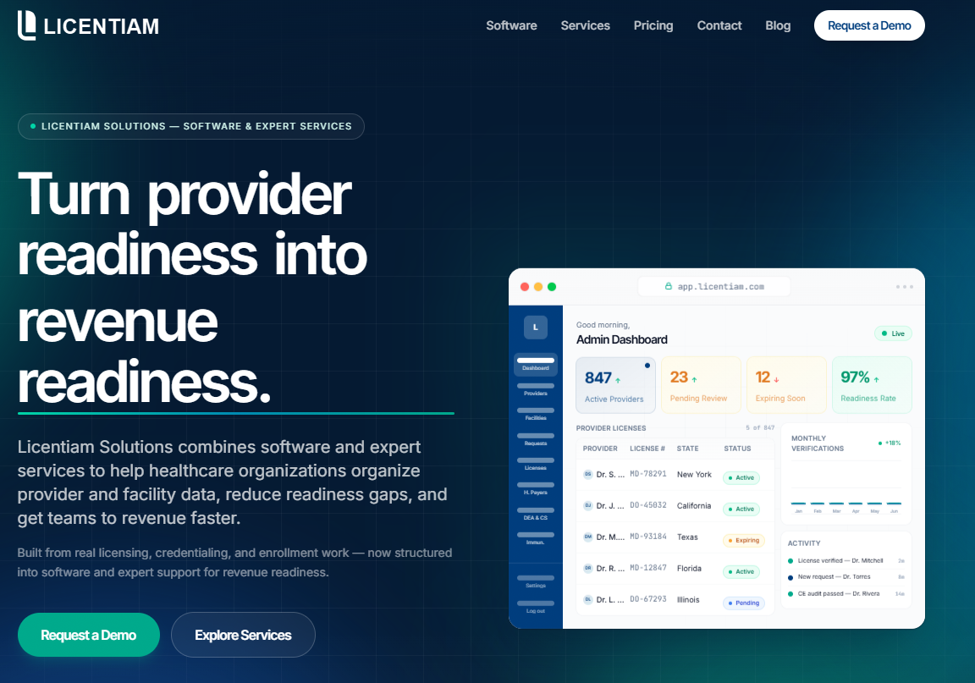
Licentiam combines a CRM system and tech-enabled services to streamline medical credentialing, licensing, and payer enrollment workflows across all 50 states and U.S. territories.
Teams use Licentiam to centralize data, standardize tasks, monitor provider status, and stay organized for audits and renewals.
Licentiam is also releasing AI-assisted automation capabilities in phases to reduce manual processes, enhance consistency, and accelerate time to revenue.
Request a demo to learn how Licentiam simplifies medical credentialing.
FAQs About Medical Credentialing
What does medical credentialing mean?
Medical credentialing means validating a healthcare provider’s licenses, education, training, work experience, malpractice history, and ability to practice medicine. Clinics and hospitals use this process to approve providers before they treat patients or bill insurance companies.
What are the three types of credentialing?
The three types of credentialing are payer or health plan credentialing, hospital or health system credentialing with privileging, and facility credentialing.
Payer credentialing enrolls providers with insurance companies to start billing for services. Hospital credentialing allows providers to deliver care.
Lastly, facility credentialing verifies that a provider has privileges in a specific hospital or clinic.
Is medical credentialing a good career?
Medical credentialing is a stable career in healthcare administration. Many hospitals and clinics are looking for credentialing specialists to meet increasing compliance demands.
How to get into medical credentialing?
You can start in medical credentialing by working in healthcare administration, billing, or compliance roles. Many professionals gain experience on the job. Meanwhile, some choose training programs or certifications to build skills and improve job opportunities.