
Before a healthcare provider can see patients, your organization must validate their credentials, work history, education, and licenses. This process is called healthcare credentialing.
Without it, unqualified providers could harm patients, their claims may be denied, and your healthcare organization might face legal trouble.
This article explains the definition and purpose of healthcare credentialing. We’ll also discuss its benefits and the steps involved in the process.
What is Healthcare Credentialing?
Healthcare credentialing, also known as healthcare provider credentialing, is the process of verifying a practitioner’s qualifications before granting clinical privileges.
Credentialing applies to doctors, nurses, allied healthcare professionals, and other medical staff who deliver care under a healthcare facility.
The process is handled by a healthcare organization’s internal credentialing department or a credentials verification organization (CVO), which verifies qualifications and handles provider enrollment on behalf of hospitals and health plans.
The Purpose of Healthcare Credentialing
The main purpose of healthcare credentialing is to confirm that providers meet established standards set by licensing boards, regulators, and healthcare organizations. These standards define who is qualified to deliver patient care.
Healthcare credentialing also helps organizations comply with payer requirements from private insurers or government healthcare programs. Without this step, claims may not be paid, which affects revenue.
Another objective of credentialing is to ensure medical proficiency. Healthcare providers undergo a rigorous process that reviews the necessary qualifications, work history, education, and training. This confirms they can provide high-quality care within their scope of practice.
Top 5 Benefits of Healthcare Credentialing
Healthcare credentialing protects patients, providers, and organizations while enabling compliant, efficient clinical operations. Here are the advantages of credentialing providers:
1. Improved Patient Safety
Credentialing confirms that providers are qualified, trained, and legally permitted to practice in the healthcare industry.
Organizations follow a structured vetting process to verify credentials, licenses, work history, and clinical competence before granting privileges. This reduces the risk of medical errors and patient harm.
2. Higher Quality of Care
Healthcare credentialing plays a direct role in maintaining high standards of patient care.
It ensures that providers meet credentialing standards and role-specific requirements, so they can deliver high-quality care.
Credentialing also tracks expired licenses, gaps in certifications, or changes in the scope of practice before they affect patient outcomes.
3. Increased Credibility
Healthcare credentialing improves organizational credibility by demonstrating a clear commitment to rules, quality, and patient safety.
When you properly credential providers, patients, payers, and partners can trust that care is delivered by qualified professionals who meet regulatory and professional requirements.
Credentialing also protects reputation through better risk management. It helps you avoid compliance failures, billing disputes, and public trust issues.
4. Stronger Compliance
Credentialing helps healthcare organizations meet requirements set by government agencies and other accrediting bodies.
These typically include the Centers for Medicare and Medicaid Services (CMS), the National Committee for Quality Assurance (NCQA), the Joint Commission (TJC), and the Utilization Review Accreditation Commission (URAC).
Healthcare credentialing continuously checks licenses, certifications, education, work history, and exclusion status to maintain ongoing compliance.
5. Faster Insurance Reimbursements and Time to Revenue
An accurate and timely provider credentialing process directly impacts how quickly healthcare organizations get paid.
Payers will not reimburse claims for services rendered unless providers are fully credentialed and enrolled in a payer network.
Proper credentialing ensures provider information is complete, verified, and aligned with payer requirements before billing begins. This helps hospitals, private practices, and managed care organizations receive reimbursements and payments faster.
How Does the Healthcare Credentialing Process Work?
Healthcare credentialing follows a structured, multi-step process to verify provider qualifications. Let’s break it down below:
Application Submission
Credentialing begins when a provider submits an application with all required documentation. This typically includes proof of proper education, training history, licenses, employment records, and disclosure statements.
During the application process, healthcare organizations also collect consent forms and attestations that allow them to validate credentials with external sources.
This step ensures all required information is available before formal review begins.
Primary Source Verification
After receiving the applicant’s application, you need to verify credentials directly with the original issuing entities. This process is called primary source verification (PSV).
Confirm degrees, licenses, and board certifications with medical schools, state boards, and certifying organizations. Do not rely on self-reported information or secondary sources, as they may be biased and inaccurate.
Conducting PSVs helps ensure credential authenticity and reduces risk.
Background Check
The next step involves background checks to assess professional risk. This includes reviewing peer references, malpractice history, sanctions, exclusions, and any reported malpractice claims.
You can also conduct criminal background checks and federal exclusion screenings to identify potential liability concerns.
If you have identified issues, evaluate them for severity, relevance, and recency.
Then, decide whether additional review or restrictions are necessary before passing the documents to an official committee.
Committee Review and Decision
A credentialing committee is a designated governing body responsible for reviewing and approving provider credentials before granting privileges.
This committee typically includes physicians, clinical leadership, compliance officers, and other key stakeholders involved in quality, risk, and operations.
Think of them as credentialing specialists who ensure credentialing decisions align with organizational policies, regulatory requirements, and patient safety standards.
The committee reviews all the information collected, including verified credentials, background checks, and risk assessments.
Based on this review, the committee may approve the provider, deny the application, or request additional clarification on missing information.
Privileging
Once approved, healthcare providers receive clinical privileges and move through payer enrollment. This marks the completion of initial credentialing, allowing providers to deliver care and bill payers for services rendered.
Make sure to record approval decisions and clarify privilege definitions. Doing so prevents providers from rendering services outside approved boundaries.
Ongoing Monitoring
The healthcare credentialing process does not end at approval. It requires continuous monitoring to ensure providers remain qualified, compliant, and authorized throughout their tenure.
Track license expirations, renewals, and compliance changes regularly. This is time-consuming to do manually, so consider using software tools to streamline the process.
Licentiam Gets Healthcare Providers Credentialed Faster
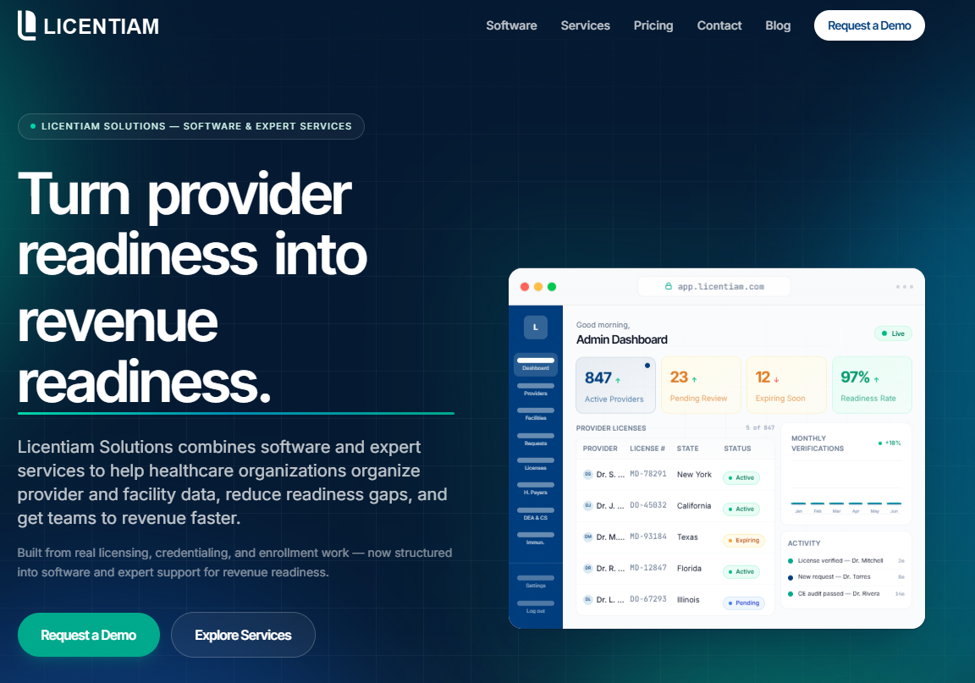
Licentiam is a full-service credentialing solution that integrates a centralized CRM with tech-enabled services. It’s designed to streamline provider credentialing, licensing, and payer enrollment workflows across all 50 states and U.S. territories.
Teams use Licentiam to store provider files, track license status, generate audit-ready reports, and standardize task management.
Licentiam is also introducing AI-assisted automation through a phased rollout to reduce manual processes, ensure consistency, and speed time to revenue.
This approach has helped teams save 3,500+ hours of administrative time—time redirected to patient care and revenue generation.
Request a demo today to learn how Licentiam simplifies credentialing!
FAQs About Healthcare Credentialing
What is credentialing in healthcare?
Healthcare credentialing is the process of checking a provider’s background before they work with patients. It includes reviewing education, licenses, certifications, and work history to confirm that providers meet required qualifications.
Is medical credentialing a good career?
Medical credentialing can be a good career for detail-oriented individuals who want to work with healthcare systems. Credentialing specialists review documents, track deadlines, and support provider onboarding.
Why do most healthcare professions require credentialing?
Most healthcare professions require credentialing to confirm providers are trained and licensed to treat patients. It helps healthcare organizations follow rules set by regulators and payers.