
Managing provider credentials is slow and risky. When you rely on spreadsheets, email threads, and paperwork, it is easy to miss a license renewal, lose a document, or forget a follow-up.
A single missing item can delay approvals and push back start dates. It can also create billing issues and impact revenue if enrollment data does not match credential status.
That’s why many healthcare operations are turning to credentialing software to manage licensing, credentialing, and compliance status in one place. The right platform can reduce manual work, end burnout, ensure regulatory compliance, and onboard providers faster.
This article reviews the best credentialing software for healthcare organizations. You’ll also learn the core features, pros, and cons of each platform to help you make an informed decision.
TL;DR
These are the best credentialing software for healthcare professionals:
- Licentiam
- Modio Health OneView
- symplr
- Medallion
- Mocingbird
Top 5 Healthcare Credentialing Software Solutions for 2026
Here is a detailed review of the best credentialing software.
1. Licentiam
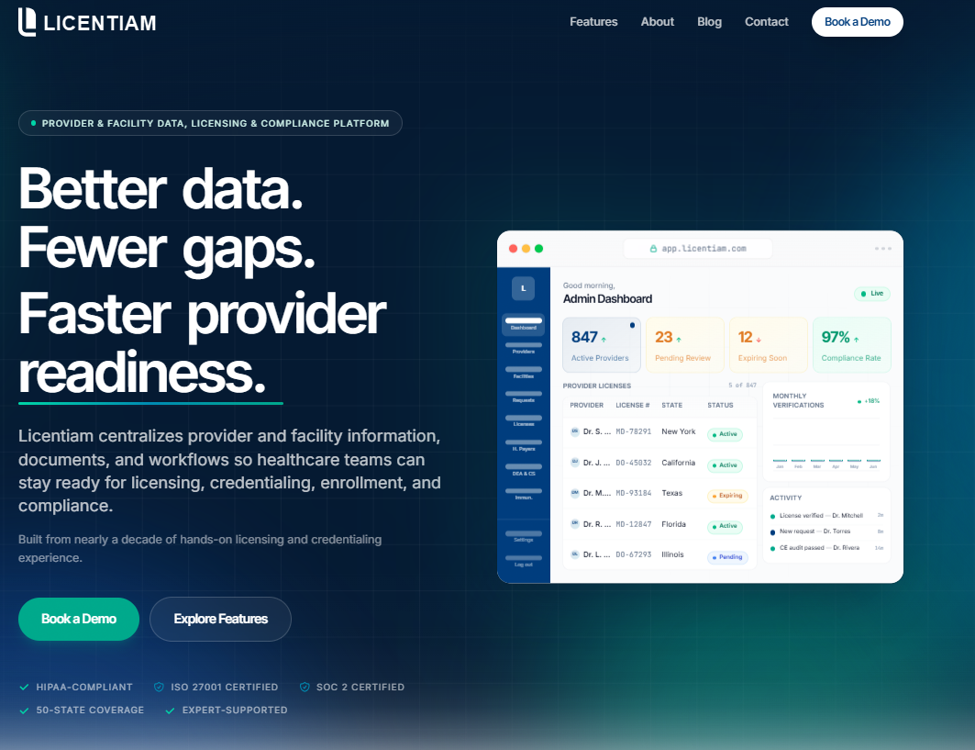
Licentiam is a full-service credentialing solution for healthcare organizations. It combines a centralized CRM and secure repository with tech-enabled services to streamline provider licensing, credentialing, and payer enrollment workflows across all 50 states and U.S. territories.
Today, teams use Licentiam to centralize documentation, standardize task management, improve visibility across provider status, and stay organized for audits and renewals.
Licentiam’s AI-assisted automation capabilities are being developed and released in phases, designed to reduce manual steps, increase consistency, and accelerate time to revenue.
Licentiam also supports ongoing compliance operations with configurable reminders and monitoring workflows (e.g., renewals and screening cadence), helping teams identify issues early and stay audit-ready.
Request a demo today to see Licentiam’s platform and delivery model in action!
Key Features
- License tracking & renewal reminders: Track state license status, renewal timelines, and required documentation across provider types (e.g., MDs, DOs, NPs, RNs).
- Secure document repository: Store provider files, supporting documents, and notes in one place for faster retrieval during audits and renewals.
- Primary source verifications: PSV workflow support with credential verification assistance, documentation tracking, and audit-ready records.
- OIG exclusion and background checks: Conduct ongoing checks against OIG exclusion lists and verify the providers’ qualifications. This ensures compliance with regulatory standards, like those from the National Practitioner Data Bank or state licensing boards.
- CEU management: Track and report on Continuing Education Units (CEUs) required for professional license renewals.
- Compliance alerts: Configurable reminders tied to expirations, submissions, and compliance tasks to reduce missed deadlines.
- Client onboarding: Structured onboarding workflows to centralize provider data and begin tracking tasks, status, and documentation.
- Reporting tool: Generate audit-ready reports and operational dashboards to support compliance and leadership visibility.
Pros
Licentiam is built on an existing, production-tested compliance CRM platform that supports agentic AI deployment for transforming paper-heavy, manual processes into scalable workflows.
This matters because manual credentialing can take more than 20 admin hours per provider. Meanwhile, delays cost over $200,000 each month per physician. Licentiam helps you save valuable time and money by automating administrative tasks.
Licentiam is more than just another credentialing software. It also gives you direct access to their established network, expert knowledge, and eight years of experience working with government and private insurance payers across all 50 states and U.S. territories.
Optional tech-enabled services, such as credentialing and re-credentialing, online notaries, license renewals, and subject matter assistance, are available at your disposal.
Schedule a demo today to learn how Licentiam streamlines credentialing and improves your bottom line!
2. Modio Health OneView
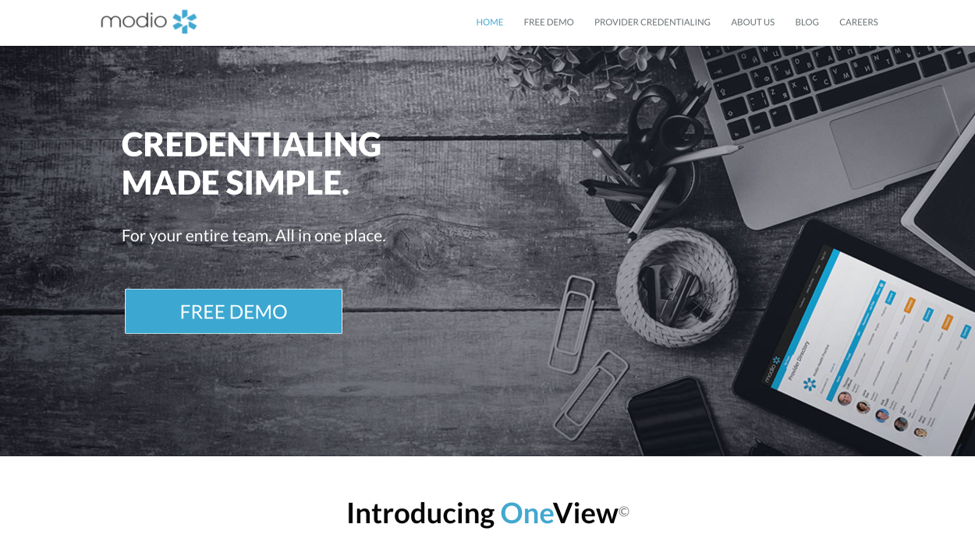
Modio Health’s OneView is a cloud-based provider credentialing software built for healthcare organizations spread across multiple locations.
It provides secure document storage where you can keep credentials, licenses, and provider information in one place. Everything is accessible from any device and any location.
OneView allows you to track payer enrollment, license renewals, and re-credentialing processes in a connected workflow. It supports one-click renewals, eliminating the need to log in to various sites.
The platform also streamlines compliance by generating real-time reports and sending alerts for expiring credentials.
For CME management, OneView helps you fulfill hours and monitor Continuing Medical Education credits. These ensure ongoing competence that enables healthcare professionals to provide high-quality patient care.
Key Features
- Document storage: Store provider files and related notes in the cloud, which allows your credentialing team to access documents anywhere.
- Workflow tracking: Support license renewal, payer enrollment, and credential tracking.
- One-click renewals: Renew licenses and certifications directly in OneView without signing in to multiple sites.
- Compliance reporting and alerts: Receive reminders for expiring DEA (Drug Enforcement Administration) registrations, board certificates, and state licenses.
- CME management: Track CME credits from your account and connect to a CME partner to fulfill required hours.
3. symplr
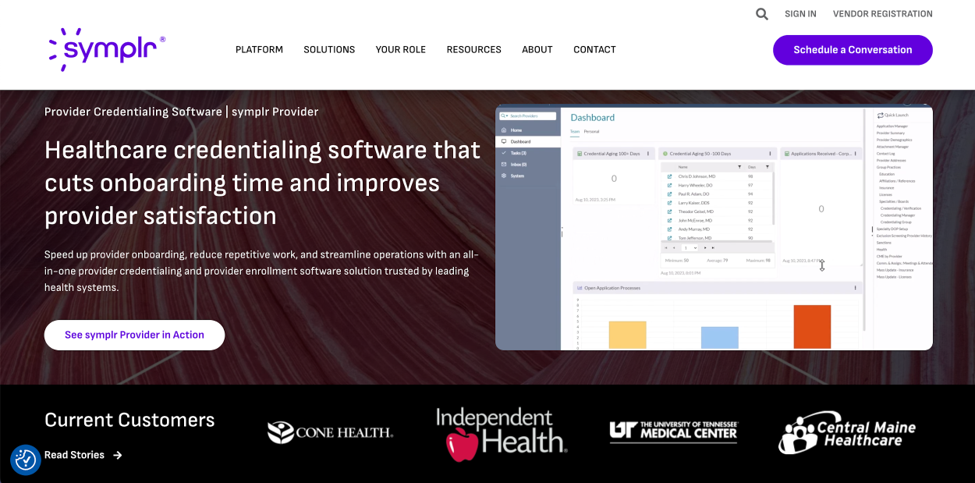
Symplr is an end-to-end credentialing solution for healthcare organizations. It handles credentialing, privileging, provider enrollment, OPPE, and provider performance, all from a unified digital platform.
It connects to primary sources and regulatory databases to automate credential verification. This eliminates bottlenecks across the credentialing lifecycle.
Symplr also provides access to an extensive library of over 9,600 delineated privileges with embedded ICD/CPT codes. It can reduce repetitive data entry and support faster privilege list development.
The platform even helps you prepare for audits. It can quickly generate reports and ad hoc queries without requiring SQL commands or programming experience.
Key Features
- End-to-end system: Manage the entire provider lifecycle, from application and credentialing to performance monitoring, in one system.
- Credentialing automation: Connect to primary sources and regulatory databases to speed up the verification process.
- Built-in privileging library: Access an extensive library of over 9,600 delineated privileges and use embedded ICD/CPT codes.
- Provider enrollment management: Track providers through enrollment and build rosters that include added, deleted, and changed data.
- Audit-ready reports: Generate reports and ad hoc queries within minutes to support auditing.
4. Medallion
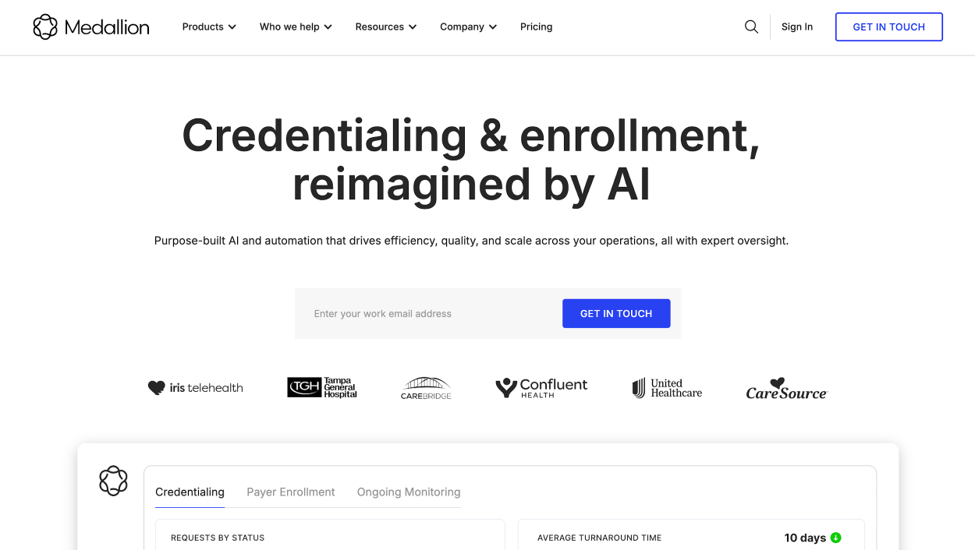
Medallion is an AI-enabled credentialing and enrollment platform that empowers healthcare organizations to scale faster.
It automates data collection with built-in human verification to ensure accuracy and compliance. It also syncs provider data from your existing systems in just one click. That means providers can start sooner with confidence.
The software delivers credentialing files electronically to speed up committee reviews. This reduces the need for spreadsheets and paperwork.
Plus, Medallion helps you stay ahead of expirations by sending automated notifications. It can even automate the re-credentialing process, so you can focus on high-value work.
Key Features
- Seamless data collection: Let the system gather up-to-date information from providers, which will undergo human review.
- One-click credential syncing: Sync important data and start provider, group, or facility credentialing in a few clicks.
- Compliance tracking and automated validations: Meet NCQA (National Committee for Quality Assurance), Joint Commission, and CMS (Centers for Medicare and Medicaid Services) regulatory standards.
- PSVs and quality assurance checks: Generate accurate credentialing files using primary source verification to help you pass committee reviews faster.
- Proactive reminders: Get notified when credentials are expiring to stay ahead of deadlines.
5. Mocingbird
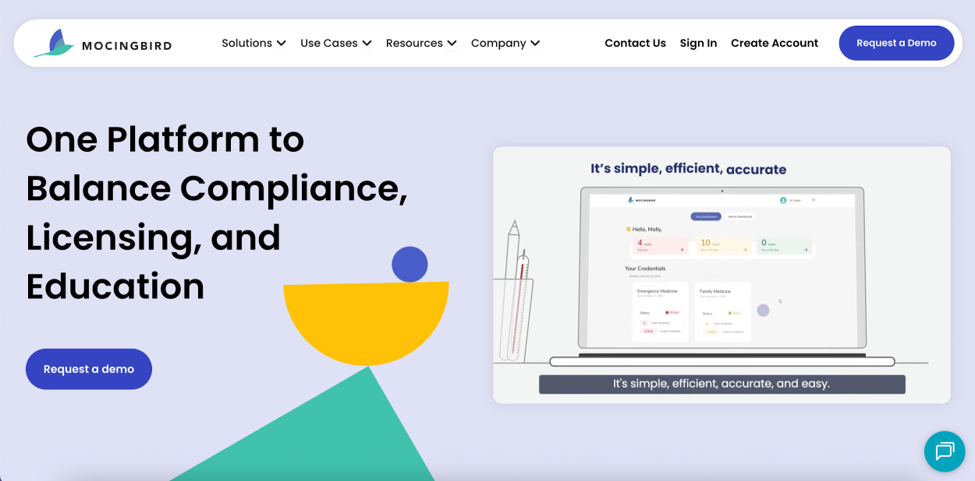
Mocingbird is a licensing, credentialing, and CME management platform that helps healthcare organizations stay on top of compliance.
The software features a credential dashboard that tracks real-time updates, compliance requirements, and licensing status. It sends automatic reminders to ensure you’re always one step ahead of due dates.
Meanwhile, an administrator dashboard monitors your entire team’s compliance status. It also provides quick access to progress reports and renewal timelines to keep everyone on track.
Plus, Mocingbird offers secure cloud storage for all your documents. Since everything’s stored in one place, it’s easier to manage credentials and CME credits.
Key Features
- Credential dashboard: Centralize licensing status and compliance requirements in one secure platform.
- Custom compliance tracking: Set up custom trackers to monitor certifications, training, and more.
- Administrator dashboard: Gain real-time visibility into your team’s compliance status.
- File cabinet: Store and organize all documents in secure, accessible cloud storage.
- Integrated learning center: Access curated CME options from accredited providers to help you stay updated on the latest knowledge in your field.
Benefits of Credentialing Software for Healthcare Organizations
Credentialing software offers several benefits to your healthcare operations. Here’s what to expect:
Streamline Credentialing Processes
Credentialing software is designed to help healthcare organizations streamline operations, including licensure, renewals, and credentialing processes.
It instantly handles many routine tasks that slow down your credentialing team. It can collect provider details, request documents, assign tasks, and send reminders when items are missing.
The platform also tracks licenses, CAQH (Council for Affordable Quality Healthcare) records, board certifications, DEA registrations, and malpractice insurance.
This reduces back-and-forth emails and eliminates the need for spreadsheets. It helps you avoid manual work and burnout due to burdensome paperwork.
Licentiam combines software and tech-enabled services to streamline credential management and reduce manual work. In client engagements, this approach has helped teams save 3,500+ hours of administrative time—time that can be reallocated to care delivery and revenue generation. Book a demo today to get started!
Accelerate Provider Onboarding Timelines
Credentialing software speeds up onboarding by keeping every step in one workflow.
Your credentialing team can set due dates, assign owners, and track status at a glance. Meanwhile, providers can easily submit forms and updates through a self-service portal, which reduces delays caused by incomplete packets.
When you shorten the time between offer and start date, you fill schedules sooner and reduce gaps in coverage.
Faster onboarding means you can scale hiring across locations without overburdening your credentialing team.
Maintain Compliance
Credentialing software supports compliance by storing verifications, approvals, and renewal steps in one place. That means you can respond faster during surveys or audits and avoid scrambling.
It helps you meet requirements from regulatory bodies by keeping timestamps, task history, and clear proof of completion.
Most credentialing platforms also send automated notifications that remind you of license expirations. This reduces missed renewals that can lead to coverage gaps or billing issues.
Centralize Provider Data
A credentialing system offers a secure data repository with contact information, licenses, work history, and documents tied to a clear provider profile.
It also helps you track other organizational records (e.g., compliance training) alongside provider files, which gives a more complete view of readiness.
When teams share one data source, you lower the risk of duplicate entries and conflicting versions. This also helps reduce confusion during employee turnover. New team members can see the full history of the provider without sorting through old messages.
Having centralized data supports real-time document tracking, cleaner reporting, and regulatory compliance.
Ensure Patient Safety
Patient safety depends on having the right clinicians cleared for the right work.
Credentialing software helps you confirm qualifications and keep checks current, so you reduce the risk of expired licenses or missing items.
It can also support committee workflows and help you monitor peer reviews by linking review steps to provider records.
With a consistent credentialing process, you can see what is approved, what is pending, and why. This supports safer staffing decisions across units and locations.
It also helps you respond quickly when issues arise, since you can pull the entire provider profile and history without delay.
Improve Patient Outcomes
Credentialing software supports better patient outcomes by helping you place qualified providers into roles faster.
When you reduce onboarding delays, you expand access to care and lower wait times for patients.
The platform also strengthens oversight by tracking licenses, certifications, expirations, and safety checks in one place. This helps confirm that healthcare professionals have the necessary training, education, and credentials to provide quality care.
Plus, it sends alerts before deadlines to avoid lapses that can remove a provider from the schedule or limit what they can do.
How to Choose the Right Credentialing Software
With so many credentialing platforms, it can be difficult to choose the right one for your healthcare organization. Fortunately, the tips below can help you make an informed decision.
- Review compliance features: Check if the software supports compliance monitoring, sends renewal reminders, and generates audit trails. These help you stay on top of regulatory compliance.
- Prioritize data security: Look for encryption, backups, data retention, and role-based access control to protect sensitive information.
- Check automation tools: You want software that automatically tracks licenses, sends reminders, and routes items for review and approval. This helps you save time and manual effort.
- Validate primary sources: Research how the software verifies credentials. It should pull from trusted sources, such as government databases, state medical boards, medical schools, and councils.
- Assess document management features: Confirm that you can store licenses, certifications, IDs, committee packets, and supporting files in one place to keep everything organized.
- Evaluate integration capabilities: Check if the credentialing platform connects to EHR systems, billing systems, and other healthcare technology tools you already use to reduce data silos.
- Compare pricing: Ask for a full price breakdown before you commit to a credentialing platform. Know what’s included in the monthly subscription and what costs extra to avoid surprises.
Streamline Credentialing Processes With Licentiam
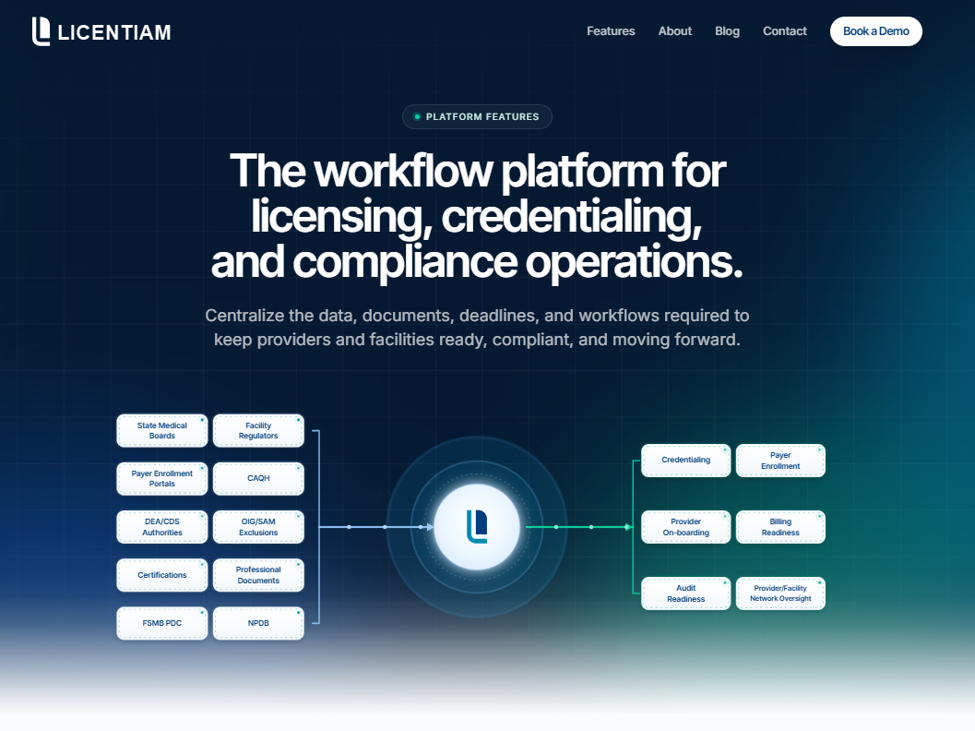
Licentiam is a CRM platform and tech-enabled services partner designed to streamline provider licensing, credentialing, and payer enrollment workflows across all 50 states and U.S. territories.
It centralizes documents, status tracking, reminders, and reporting today, with AI-assisted automation rolling out in phases to cut manual steps and speed time to revenue.
Licentiam also offers built-in license monitoring, OIG exclusion and background checks, PSVs, secure document repository, CEU management, and audit-ready reports. These empower healthcare organizations to stay on top of license and credential management.
In fact, Licentiam has helped an enterprise client track and monitor credentials for all its healthcare providers. Licentiam’s team and platform helped track and validate provider licenses and credentials to support compliance with State boards and insurance payer requirements.
Over the first six months of the engagement, Licentiam saved more than 3,500 hours of administrative time. It also significantly improves regulatory compliance and enhances the client’s reputation within the industry.
Request a demo today to learn how Licentiam simplifies your operations!
FAQs About the Best Credentialing Software
What is the best credentialing software?
The best credentialing software depends on your specific needs and healthcare requirements. Top choices include Licentiam, Modio Health OneView, symplr, Medallion, and Mocingbird.
What are the three types of credentialing?
Healthcare organizations usually work with three types of credentialing. Provider credentialing verifies a clinician’s education, training, and licenses. Payer credentialing enrolls providers with insurance companies so services can be billed. Facility credentialing confirms that a provider has privileges to deliver care at a specific hospital.
How much does credentialing software cost?
Actual software costs vary based on provider count, locations, features, and customer support. Some credentialing tools start with lower monthly plans, while enterprise platforms use custom pricing.